Welcome to the Science of Sport, where we bring you the second, third, and fourth level of analysis you will not find anywhere else.

Be it doping in sport, hot topics like Caster Semenya or Oscar Pistorius, or the dehydration myth, we try to translate the science behind sports and sports performance.

Consider a donation if you like what you see here!


Did you know?
We published The Runner's Body in May 2009. With an average 4.4/5 stars on Amazon.com, it has been receiving positive reviews from runners and non-runners alike.

Available for the Kindle and also in the traditional paper back. It will make a great gift for the runners you know, and helps support our work here on The Science of Sport.


Showing posts with label heat. Show all posts

Saturday, October 09, 2010

Chicago Marathon 2010: Heat and performance

Exercise in the heat and Chicago 2010 Preview


Just one day to go now before 10-10-10, as we continue our build up to Sunday.  Earlier this week we took a look at some recent close finishes in the marathon world, two of which occurred here in Chicago.  Today we are going to take a look back to the 2007 race, when unseasonably warm and humid conditions wreaked havoc on the race and forced a premature closure.  The events surrounding that day sparked much discussion and debate here on the site, and sparked our first series, a five-part series on exercise and dehydration.


The most recent forecast for the 2010 race is looking excellent with warmer temps than normal, but minus the suffocating humidity from 2007.  The cooler morning temps might even be mild enough to facilitate a world record---providing Wanjiru can get his pacing right, but that's another post entirely.  For now we will take another look at the effects of heat on performance, and how elegantly we are able to balance our heat production with our losses so as to prevent disaster.


Given:  Heat affects performance


Few would argue this point, because inherently we all know that when it gets hot outside, we slow down.  Of course this occurs without even thinking about it, which is the remarkable part of our physiology.  So on race day 2007 none of those athletes had to first become too hot before slowing down, and instead were already running slower even from the gun.  And the effects of heat on performance are well know and documented so that we can expect a 3-5% decrease in performance compared to cool or neutral conditions.  And in fact that was bourne out in the 2007 race, as the winning time was "only" 2:11:11 compared to most other years when the winning time is between 2:05-2:07.


You might be thinking that is an awfully small difference, but remember we are dealing with the differences in performance in the most highly trained athletes, who have the best ability to cope with the heat not only because of their training status, but also because this group benefits from a smaller body mass.  In fact if you go farther down the field and analyze the every day runners, which we have, you find that the lesser trained and what are most likely "normal sized" athletes are affected in a more dramatic way.

In this first graph, we have compared the 1st, 100th, 1000th, 10000th, 20000th, 99th percentile, and the mean finishing times from 2005, 2007, and 2009.  (Click to enlarge it.)


At a glance you see that the yellow bars, 2007, are generally taller than the other two years---so that is the effect of the heat on performance.  Also, you can see that for the faster finishers the difference is smaller, which tells us they are less affected by the heat.  Interestingly, the 1000th finisher in 2009 was almost 30 min slower compared to 2007, and likewise for the 99th percentile time---it was actually faster in 2007 compared to the two other years.


Admittedly, the absolute differences might not be the most meaningful a way to evaluate the data, which is why we have looked at the relative differences between 2005 and 2007, and between 2007 and 2009.  Again, click to enlarge the graph:
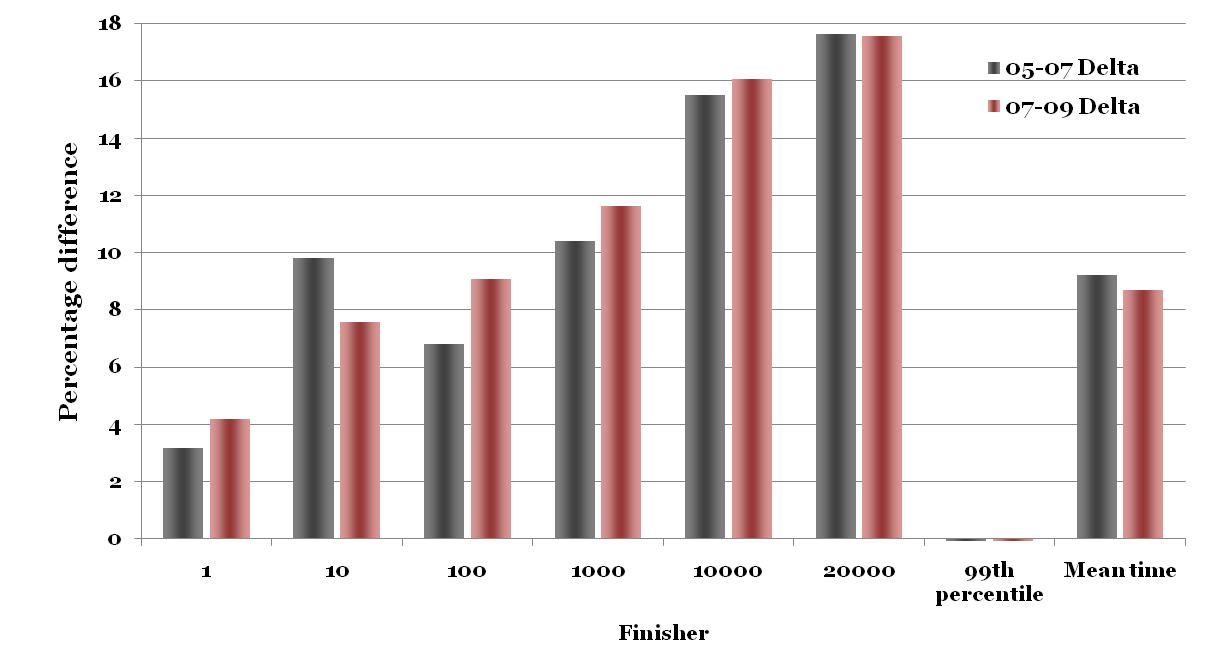


The black bars are the percent different for each finishing place between '05 and '07, which the maroon bars represent the percentage difference between the '07 and '09 races.  Therefore the winning time in 2007 compared to 2005 was about 3% slower, and compared to 2009 the winning time in 2007 was about 4% slower.  This graph shows how as we go down the placings, the slower runners are affected more by the hotter temps, although perhaps at a point---probably where the people are basically walking the entire course, this effect is absent as noted by the 99th percentile finisher.  But on average the times were 8-9% slower in 2007 compared to the '05 and '09.


Don't remind us:  We know the limitations


Before the science stick comes out and we get pummeled with it, we know this is not a definitive analysis of the effects of heat on performance.  We simply grabbed the "X" placed finishing time from each of the three years and looked at how they compare.  Admittedly, looking at percentiles might be slightly better, so we encourage you to crunch the numbers with us---all of the data above are available on the Chicago Marathon website.


Regardless, we still think this paints an interesting picture of how the heat affects performance across a range of running abilities.  Most interesting but maybe not surprising is the finding that the 99th percentile times are effectively the same independent of the environmental conditions.  The reason it is not so surprising is that at that pace---between 6:00-6:30---the "runners" are effectively walking the entire distance or a very large proportion of it, and in doing so they are mitigating the effects of the heat on performance.


Quick preview of the race:  Whip out the SoS crystal ball!


It would have been great for American running, and also for Ryan Hall, if Ryan Hall could have raced against Kebede and Wanjiru.  I think at some point the pace would be too much and he would get dropped, but like Sammy Korir in Berlin 2003 he might have been pushed to a new PR and possibly a new American record.  But given Wanjiru's and Kebede's last few performances, they are the hot favorites.  Wanjiru was unbeatable between 2007 and this year, winning the Olympic gold, London and Chicago last year.  2010 has seen a drop in that form - a DNF in London his worst major marathon performance.  That race was won by Kebede, who has, in his last two marathons, established himself as the eminent marathon runner of 2010.


The race is likely to go one of two ways.  The pace could be suicidal from the gun, as in London 2009 (recall the 1:01 half split! or Chicago 2009 (29:11 for 10 km, 44 min for 15 km).  If that is the case by halfway or shortly after, expect a small pack of 4-5 runners to have formed - this is arguably the strongest ever Chicago Marathon field, and has five runners all with sub 2:06 credentials in it.  The race between these five should last at least to 32km.   What happens from there is maybe anyone's guess - if Wanjiru has regained his 2008-2009 form, then expect him and Kebede to be last men standing.  


The race is full of potential champions though - Robert Cheruiyot produced a sub-2:06 performance in Boston this year, an astonishing performance that many felt is worth a 2:04 (at least) on a Chicago-like course.  So even at world record pace, he'll be in contention.  So too Deriba Merga, the aggressive Ethiopian, will have a say in the race - he may not win it, but he'll dictate how it unfolds with his racing style.  Then there are Vincent Kipruto (3rd in Rotterdam this year) and Feyisa Lelisa (4th in Rotterdam), both sub 2:06 runners. 


The conditions are going to be near optimal for the record to fall, and with five sub-2:06 performers, including Wanjiru and Kebede in the race, it may well be on.  If the wind cooperates (and it might, as the forecast is for SW winds as the day progresses, giving them a potential tailwind down the home stretch) then it all depends on how the race unfolds.  The other option for the race is that it might be fast in the beginning, but the presence of so many potential champions may see the race become more tactical.  In that case, watch for Merga or  Cheruiyot to steal the show much as Marilson Gomes dos Santos did in New York in 2009 while Tergat and the other contenders were busy marking each other.


A friend of mine saw Merga in the hotel lift on Thursday, and he asked him what he would run on race day.  "2:04," he replied.  Whether or not Merga has that kind of speed is debatable, but this is not---he will attack and attack again and stay with the pace for as long as he can.  His 1:02:31 at 2500 m in Colombia is telling, but probably not quite worth a 58:xx time at sea level and therefore probably not good enough for a 2:04:xx marathon.  Our guess is that even if the pace is high, which Wanjiru is known to do, Merga will be able to stay with and even attack up to 30+ km, but will fade after that, perhaps hanging on for a 3rd or 4th place finish behind Kebede and Wanjiru.


On the women's side, it should be a four-woman race between defending champ Liliya Shobukhova, 2008 champ Lidiya Grigoryeva, World Marathon Majors champion Irina Mitikenko and Ethiopian Askale Tafa Magarsa---who ran 2:21 in Berlin 2008.  On paper all of them match up more or less equally, so it could be a really amazing race between those four, but we are unlikely to see any of them come close to Paula Redcliffe's 2:17:187 course record from 2002.


Race day coverage


I will be in the medical tent on race day keeping track of the environmental conditions, but we will be updating the site with live splits from the men and women as well as updates as the race unfolds.  After the race you can expect our normal analysis of the performances and pacing, so be sure to come back and also to join in the discussion!


 Jonathan

Thursday, September 02, 2010

Dear Sports Scientists: Will drinking fluids keep me cool?

Another look at fluid ingestion and temperature regulation


First, if you did not catch the NY Velocity interview with Ross, be sure to---Andy Shen and co do a great job over there and produce some excellent interviews.  Their site is a must read for any serious or enthusiastic cyclist, whether or not they reside in NYC.

Back in June I was very fortunate to present two sessions at the National Athletic Trainers Association annual meeting in Philadelphia, PA.  Both talks were about fluid ingestion, temperature regulation, and dehydration, and last week I received the audience feedback from the two sessions.  As usual the sessions produced polarized views on the subjects.  So I thought it might be a good time revisit this topic, one we have written about quite a bit on the site and in The Runner's Body.  After all, it is the end of summer, it is hot and humid, and plenty of people are training and racing in the heat.

The title of this post was not inspired by an email we received, but one of the core junctures where the two sides of this argument split is how much fluid is the right amount and why athletes should ingest it.  Nearly everyone will agree that ingesting fluid does have an effect on one's ability to regulate core temperature.  However one side of the argument is that athletes should try to maintain weight losses or lose less than 2% of their starting mass, while the other side feels ingesting fluid to thirst (which normally results in weight loss and some "dehydration") is the best practice.

Why ingest the fluid to prevent or minimize weight losses?  Well, some might argue that if we do not, we get too hot and this predisposes athletes to "heat illness."  The exact meaning and relevance of "heat-illness" is debatable and probably deserves its own post altogether, but the rationale for warding off dehydration by minimizing weight losses is that dehydration causes a rise in core temperature, and that causes heat illness, and that it might even cause heat stroke according to some.


The lit review (in brief!)


The evidence used to support the practice of replacing all or most of your weight losses comes from studies that control for the workload while asking subjects to run or cycle in hot and humid conditions.  The smaller scale studies measure weight losses (and sweat rates) and core temperature, the larger scale ones look at cardiac output and skin blood flow, among other variables.  This is good science, because if we permit our experimental subjects to speed up and slow down then suddenly we cannot determine what is affecting core temperature because now we have two independent variables (intensity and fluid volume) instead of one (fluid volume).  Therefore I am not slating those studies and authors and accusing them of bad science.  


The conclusions are that dehydration, as measured by weight losses, increases cardiovascular strain and results in an elevated core temperature at the same workload.  Fair enough, and as I mentioned earlier I do not think anyone, us included, will try to say that fluid ingestion has absolutely no effect on core temperature---it does, and these studies all demonstrate this effect.  And in fact their science is good, but it is the application of the conclusions that are bad.  In writing a scientific paper it is quite easy to wander off and begin to speculate about why you found what you found.  And it is at that point in your discussion that the reviewers let rip and often times sharply remind you to remain within the confines of your data and draw conclusions based only on what evidence you have available to you (i.e. your data)!


The issue with this topic of fluid and temperature is that the data are all collected within a strict set of conditions---as dictated by the scientific process--but then applied to every athlete (slow, fast, recreational, competitive, elite) in any situation (practice, race, fun) and any condition (cold, warm, hot).


Size counts


The size and magnitude of this effect is terribly small, however.  I try to teach my students in my stats class the difference between statistical and practical significance, and this is a classical exercise for this.  Take the absolute difference between the core temperatures at the end of a typical study, where the subjects exercise for up to two hours.  It is typically between 0.5-0.8 C, or maybe 38.x C in the fluid trial and <39.5 C in the no fluid trial.  Statistically significant?  Yes, most likely.  Practically significant or meaningful?  You are allowed to disagree, but I say "no."


And to follow up with that conclusion, the advice to replace fluids and prevent dehydration is dished out from this evidence even though none of the subjects in these trials ever report signs or symptoms of "heat illness."  So perhaps the real story is that even when we exercise in hot and humid conditions, our core temperatures rarely reach critical levels, and we cope with the additional stress just fine as evidenced by the lack of symptoms.  To me it begs the question, "Why are we telling people to follow this practice," because although there is a difference in temperature, it is small and not otherwise meaningful.


Ingesting fluid keeps does not keep you cool


Long ago, in an exercise lab far, far, away (ok, in Fort Worth, TX), some bored or motivated (or both) students were testing an athlete preparing for the Honolulu Marathon.  At the end of the heat acclimatization period, the runner did a performance run (80 min) at marathon pace (14-15 km/h, or  8.75-9.4 mph) and ingested quite a large volume of fluid (1.75 L) while we measured the rectal temperature response.  He did not ingest quite enough water to prevent weight losses, but came pretty close, losing only 1.6% of his body mass pre to post.


And by the way, the conditions in the heat chamber were 27.3 C and 60-65% relative humidity---the expected conditions on race day in December in Hawaii.  

So if the model is that you must prevent or minimize weight losses, and that you must do that to prevent an excessive rise in core temperature, and this model is based on the evidence I mentioned earlier, how does one explain the graph above?  According to that model, this athlete should be no where near 40 C since he lost only 1.6% of his body mass and was only minimally "dehydrated," yet after 80 min he is nearly to 41 C.  And herein lies a problem, because if some data do not support a particular conclusion, said conclusion must be scrapped and we must formulate a new one that incorporates all the available evidence.


Therefore it is not the fluid you ingest that keeps you cool, but as we have written here before it is your metabolic rate, or how hard you are exercising, that really predicts your core temperature during exercise.  Do not mistake what I am saying here, though---fluid plays a role, but only a very small one, and more importantly when we permit athletes to pace themselves they just slow down in the trials where they do not drink or receive very small volumes of fluid.  The result is that they reach the same core temperature at the end of the time trial, but take a little longer to finish.

For me the bigger message is that if performance is a desired outcome, if the runner wants to go as fast as they can, then they should drink to thirst.  Ingesting volumes that are larger than that have not been shown to produce faster performance times.  If performance is not important, the evidence from where I am sitting tells me that ignoring thirst and/or ingesting very small volumes of fluid will result in a miserable day out, but will not cause you to get heat stroke or collapse---two conditions that result from mechanisms other than changes in fluid balance.

If using a "hydration system" and lugging an additional 1-2 kg of mass during training runs makes you feel better, then please continue, but just know that you are not lowering your risk for anything by doing so.  The normal response is to replace less than what we lose, and it is perfectly normal and healthy to drink to thirst.

A look ahead:  Running economy and the marathon WR

Meanwhile, the Fall marathon season is upon us!   Berlin is around the corner and Chicago is boasting a super hot field that, under optimal conditions, is capable of a record.  Earlier we looked at the Joyner paper but left it before discussing what kind of running economy it would take to break two hours, so watch out for that analysis!

Jonathan

Friday, October 16, 2009

Ross speaks: Fatigue and the brain

Anticipatory regulation of exercise

Apologies for the delay in posting after my lecture last week at UIC - the Chicago Marathon came and went, and since then, travels have taken too much time to post properly.

However, what I've done below is post segments of that talk, which was titled "Limits to exercise performance: World records, fatigue and unphysiological performances".  Unfortunately, Jonathan was a little off at an angle, but hopefully the video is clear enough and the sound good enough to make out the argument.  Just in case, the diagram is shown below the video, so you can follow it there (hopefully).  Also, if you're getting this as an email, the YouTube clips might not play, so you may have to click here to go to the site and view the clip there.

The first video, 3:56 long, presents a model which I wrote about in an article published earlier this year in the British Journal of Sports Medicine, called "The anticipatory regulation of performance: the physiological basis for pacing strategies and the development of a perception-based model for exercise performance" (BJSM, 2009 Jun;43(6):392-400)


The model explained:  Complex anticipation and RPE

Obviously, you're watching a part of a presentation slightly out of context, but hopefully it gives you the basic idea.   This is a topic that has been covered a few times on the site - in fact, there's a whole series on Fatigue for those who are interested.

To summarize, your ability to regulate pace (which is something I'll bet you've never even think about) is vastly more complex than you may realize.  Even the most basic decision of how fast to start a 5km versus a 10km race is the result of innumerable calculations, which take into account previous experience, training, motivation, environment (internal and external) and physiological changes during exercise.

It really is a remarkable system, and one which we believe is primarily regulated by the perception of effort.  This is something you probably also haven't thought about much, but the way you perceive exercise is in fact so enormously complex that science is many years away from understanding it.

There is debate in science about whether your perception and the regulation of the pace is done consciously or sub-consciously, and that's where the debate seems "stuck" (or centered) right now.  I suspect that, as with most things, it will turn out to be a combination, for conscious regulation is obvious (you choose to slow down), but so is unconscious regulation - you don't have to think about starting pace, and you also slow down 'involuntarily' during exercise, even though your perception of effort is not necessarily raised (very important point this).

To explain, the physiological inputs before and during exercise result in a conscious perception of effort, which is then interpreted based on the expected duration and the "template RPE", which is a construct representing what would be considered an acceptable rise in RPE.  This interpretation of RPE underscores why exercise intensity changes dynamically during exercise.  It explains how motivation impacts on performance, and it accounts for the effects of changing conditions on performance.  This is why you speed up at the end of a race, even though your body temperature may be close to limiting, whereas you slow down in the middle, when you are not hot.

The idea that your physiology 'controls' pacing is flawed, because it ignores the importance of context - not all physiological inputs are interpreted equally!

Applying the model to the heat

The next video, shown below (2:30 long), shows a simplified model for what would happen during exercise in the heat.


We know that if your body temperature hits 40 degrees (maybe a little higher in highly motivated elite athletes), your ability to exercise is limited - this temperature is associated with nervous system failure, lack of co-ordination, dizziness, and a failure to activate muscle.

Put simply, if you hit an internal temperature of 40 degrees, your race is basically over - you either walk to the finish line, or you fall over in a cool spot and hope to cool off!

But luckily the body is too smart for this - the pacing strategy is adjusted in advance of this failure.  The previous video, on the RPE and the model for regulation, explains how this would happen.  What this second video is showing is that the 'calculation' is made in order to balance the requirements for fastest possible time with physiological 'safety'.


Obviously, stopping at the 36km of a marathon is failure.  So too is death from heatstroke.  But, equally bad is running twenty minutes slower than you could have done, because your brain has been "too conservative".  So the balance is achieved by forecasting the physiological outcome of current behaviour.  Put simply: "If I continue at this pace, storing this heat, will I finish the race before I run into danger?"

On a hot day, when heat storage is higher thanks to reduced heat loss, the answer may well be "NO", in which case the brain reduces muscle activation and thus pace, and the race can be completed in a slower, but feasible time.  The endspurt at the end comes when the body temperature is at its highest, but the risk is now absent, because the brain takes into account the exercise duration remaining, as explained previously.

So that is it in a nutshell - it's not all dreamed out of thin air, mind you!  The BJSM paper I linked to above contains all the references and evidence on which this model was built, so feel free to check that out!

Travel update

Just a quick travel update, seeing as how I'm making my way across the nation meeting all kinds of interesting sports science-related people:  I'm now in the Rocky Mountains, at an altitude of 3,500m, where I am learning new respect for Kenyan and Ethiopian runners who train at this altitude all the time!  I run at least a full minute per kilometer slower than normal, but my lungs feel as though they've completed 10 consecutive 800m races.

I head to Boulder tomorrow, where I will meet with a number of coaches, athletes and experts, and I'll be sure to interview and post interesting comments here.  So join us then!

Ross

Thursday, January 29, 2009

Australian Open heat

The Australian Open burns up, on and off the court

Well, just two days after we did our post on the Australian Open and Novak Djokovic's troubles in his quarter-final against Andy Roddick, and Melbourne enjoyed its hottest day in about 60 years, and third hottest ever! The mercury hit 44 degrees celsius (at least, that's what it was reported as on the TV coverage I saw of the games), and even at 8pm, it was in the mid-30s, which is incredibly hot for tennis.

Both Jonathan and I studied the heat during our PhD's - Jonathan looked at fluid needs and I looked at fatigue and performance, but they were both during running or cycling exercise. However, it's a topic that we enjoy, and it's interesting, so I thought I'd devote another discussion to it.

The roof issue - should we even bother about the heat?

In my post a couple of days ago, I wrote that they'd need to have stadia with retractable roofs, which it turns out they do have - two of them. I knew that the main arena (Rod Laver Arena) had a closable roof, but during Djokovic's match, the roof was open and that led me to overlook that the HiSense Arena also has a closable roof (which has since been closed for matches, I gather).

What is interesting to me, apart from what I mentioned last time, is that the only "cooling" method the players are using is a towel, presumably filled with ice, around the neck during changeovers. Verdasco, Nadal, Tsonga, and Simon have all used the same method, and I'm still not clear on why they don't have other forms of cooling when they can. The air-conditioner idea still seems reasonable.

The question, philosophically, is whether tournament organizers should worry about trying to manage the climate for the players by closing the roof and providing other cooling options? I have heard a number of commentators in the last few days debate the merits of closing the roof vs. keeping it open, and also whether the tournament should be moved later in the year.

On the latter issue, I think the decision to move the tournament, as Campbell noted in his comments to our last post, is one that should be made for a number of reasons, one of which is the weather. But I think the need for a longer off-season trumps even this, so it's not directly relevant to the debate.

As for closing the roof, the tournament has a policy, which you can read here (thanks to Campbell for the link). It's an interesting read, not least of all because it includes reference to the debate between organizers and sports scientists. It turns out that the scientists have strongly recommended that the roof be closed DURING matches, whereas the policy is that all matches in progress must be completed before this happens. Interestingly enough, during Serena Williams' quarterfinal win against Svetlana Kuzentsova, the roof was closed after the first set, so it seems the policy is bending...

The heat and health - how dangerous, how important

I guess the real issue in answer the question is to understand what happens to the players in the heat. I came across this really interesting article from the New York Times which describes the reaction of a number of players to the heat in New York in 2005.

The main protagonist was Djokovic (a man who has had a few run-ins with the "law" as pertaining to medical timeouts), who took numerous breaks during a 4-hour marathon against Gael Monfils.

Heat syncope

It speaks also of Michael Lodra, a Frenchman who fainted just after retiring from his match and had to be revived. Physiologically, what is happening here is that the body is trying to lose heat by sending blood to the skin. While exercise continues, the blood pressure is defended, because contracting muscles help to keep the circulation in balance. The problem is, as soon as exercise stops, the so called "muscle pump" stops working, and all of a sudden, all the blood "pools" in the skin circulation and with the active muscles. The result is that the blood pressure falls and the player or athlete will faint.

This is actually the same thing that happens to long distance runners who finish an event and promptly collapse. It's not that they have overheated - it's just that their bodies are trying really hard to correct the blood pressure, and given no other choice, it causes them to collapse so that they don't have gravity to work against. It's a protective mechanism.

The trouble for tennis is that it's a stop start activity, and so the chances of such a blood pressure disturbance would be increased. I suspect this is behind much of what affects tennis players in the heat - they get dizzy, "delusional" (in the words of Sharapova from the policy article).

Heat-induced fatigue

The other symptoms, like weak legs, shaking, exhaustion, are symptoms of what the brain is doing to try to regulate the physiology by controlling performance. The heat will cause a gradual rise in body temperature, which will cause the athlete or player to pace themselves differently to prevent themselves from becoming hotter. That's why a match in the heat will be slower, have shorter points, from the outset, because the entire dynamic of the game changes.

Now, for the philosophical question: Should we worry about controlling the climate for the players? Or is the heat part of the challenge and the strongest survive? Personally, I believe that if one can cool the court by closing the roof and having court-side air-conditioning, and if the quality of tennis improves as a result, then do it.

I appreciate the importance of fitness and conditioning and that a great player should spend time acclimatizing to the conditions, but this only goes so far. Acclimation to the heat, incidentally, takes place in about 10 days, but never cmopletely corrects the performance impairment. So we can talk about spending two weeks getting used to it, but the quality of tennis will still be impaired. And I for one would like to watch matches where the best player wins and you don't have controversy about players taking medical time-outs, retiring and generally introducing what might be an uncontrollable variable into the outcome (because we don't really understand why athletes respond to the heat as they do). So, like those other sports scientists, I am with the players on this one...

Speaking of performance...

Speaking of performance, the action has reached a climax with the women's final line-up confirmed (Serena W vs. Dinara Safina), and the men's final a matchup between Switzerland and Spain. Switzerland, predictably, will be represented by Roger Federer. For Spain, however, we must wait until tomorrow to know whether it will be Nadal or Verdasco.

I'm rooting for Nadal, if only so that we can see a matchup between these two again. The last one was classic, maybe the highlight of 2008 (in all sports, even better than Bolt in Beijing), and I'm being greedy.

Nadal was brilliant against Haas and in his other early matches. Federer has been brilliant in his last two. Nadal struggled a little against Simon. I still think he's vulnerable to heavy-weighted shots with depth (who isn't?), and his heavy top-spun forehand often tends to land short. Against Gilles Simon (who really is great to watch - he covers more court than anyone I've ever seen and he's so attacking), Nadal was very much on the backfoot. Yet he still won in straight sets. If he plays that way against Federer, he'll lose. If he produces a performance like that against Haas, he wins.

Should be a great game!

Ross

Tuesday, January 27, 2009

Australian Open

The Science of Tennis: Heat, revs and rankings

The Australian Open tennis tournament has now moved well into its second week, with the semi-finals looming on both the men's and women's sides. So far, it has been a fascinating tournament for many reasons, and I thought I'd do a short post looking at some of the more scientific and topical issues that have arisen.

The heat - Djokovic succumbs and matter wins over the mind

The first of those is the incredible heat of Melbourne and its effect on the players. The day-time temperatures have regularly approached 40 degrees (over 100F), and for those players with afternoon matches, the prospect of a 3-hour match must be the hardest thing they'll do all year.

There are a number of problems with playing a sport like tennis in such hot conditions. We've previously discussed the heat and how it affects a sport like marathon running, where the progressive increase in body temperature threatens to "short circuit" the system once the body temperature hits about 40 degrees celsius. The brain then fails to recruit muscle, and evidence exists that exercise is forced to terminate thanks to a failure of muscle recruitment.

The point we've often made in our posts on fatigue and more recently in our "Mind over matter" series is that the brain actually takes control long before this happens, and people start reducing muscle activation BEFORE they overheat. In a sport like running, this is seen as a slowing in the pace right from the outset.

In tennis, you can appreciate that it's not quite as simple as this. "Slowing in the pace" in tennis effectively means giving up on the ball, and in the first hour or two of a tennis match, no one will do that. You will not see a world class tennis player giving up on a rally that early. So the "pace" is effectively forced on the player by the opposition and the ball.

This means that the "pacing strategy" is a little more complex than in running (though of course, tactics during running may do the same thing). Having said this, there is some evidence that players "pace themselves" during tennis matches in the heat, by going for winning shots sooner and shortening the length of rallies. I am trying to find this study, which I know was done as part of a PhD thesis in Australia, and which found that players "decide" to play shorter points when it is hotter, which is quite fascinating.

However, returning to Djokovic, the problem is that when a match goes on into a third or fourth hour, and the player does a number of repeat efforts, the body temperature can climb quite quickly to reach these potentially limiting levels. We know that repeated sprints are just as effective at raising body temperature, and so the fact that they players have a short recovery during change of ends only serves to slow down the rise in temperature.

The result, as we've mentioned, is that the brain fails to activate muscle, and the player becomes lethargic, unable to sprint, dizzy, loses concentration, heavy-legged. If you watched the match between Djokovic and Roddick this morning, you'll have seen that in practice, as Djokovic got slower and slower until eventually, he was forced to retire at 1-2 in the fourth set, in a match he almost certainly was destined to lose given his physical state. He joins Victoria Azarenka who succumbed in her fourth round match against Serena Williams, while leading by a set.

What can be done about it?

Apart from rescheduling the tournament to take place later in the year, when it's cooler, there is only a limited amount that can be done. A stadium with a roof might help, provided air conditioning could be provided, but the expense and time involved (look at what has gone into turning Wimbledon's Centre Court into an enclosed arena) are likely to prevent that. One thing I have been surprised to notice is the absence of air-conditioning for the players at their chairs. Perhaps it's just not visible on television, and someone can correct me, but it seems that players do not really actively cool themselves between changes of ends. Even having half a dozen air-conditioners around the court at ground level, just to lower the temperature by 4 or 5 degrees would have an impact. That would be the only help given the current scheduling and conditions.

Speaking of scheduling, it's also amazing how many players get injured during the Australian Open. Perhaps two weeks of competitive tennis so soon after an end-of-season holiday is too big a demand on players, but the number of players nursing minor injuries, or forced to retire thanks to more serious injuries this early in the year is quite amazing. In a perfect world, the season would only start in mid-January (rather than on the 2nd), giving players 6 weeks off at the end of the year, and the Australian Open would take place in mid-February. Sport overload - threatens to run the game into the ground...

Rotations - an interesting study on Nadal

On another matter, I read in Time Magazine recently that Rafael Nadal's forehand has been measured with a high-speed camera, and he generates an average of 3,200 rpm on the ball, thanks to his extra-ordinary forehand stroke. By way of comparison, Roger Federer generated an average of 2,500 rpm on his forehand, while Agassi clocked in at 1,800 rpm. That means that Nadal's rotation is 25% greater than that of his closest rival, Federer, which is quite extra-ordinary (incidentally, Nadal's peak rotation was 5,000 rpm, even more amazing)

The implications of this are interesting, and are both positive and negative. For one thing, the enormous spin on the ball brings it down much more rapidly, which means that Nadal can clear the net by a much larger distance and still land the ball in play. In his Australian Open match against Tommy Haas, it was reprorted that his average clearance was 1.8m, while Haas cleared the net by only 1.1m. That difference represents a margin for error that reduces the errors made by Nadal substantially. The other advantage is the enormous bounce and kick Nadal gets off the court - in the Time Magazine article, Brad Gilbert is quoted as saying that a rally against Nadal is a "lesson in pain", because of the heavy shots he hits.

On the downside, the heavy spin means fewer winners will be hit, because a flatter shot takes time away from the opponent, whereas the higher top-spin shot that clears the net by 2m gives the opponent time to cover the court. This is often evident when Nadal plays, particularly towards the end of last year, when he was perhaps a litte fatigued and hit shots with a little less power and depth. The other problem, which has made the news recently, is the enormous strain on Nadal's body as a result of the effort that goes into generating that spin. The general consensues is that he is far more injury-prone than Federer, who seems to float around the court.

My opinion is that Nadal should limit his "exposure" and play only the Master's Series events, and the Four Grand Slams, and not bother with smaller tournaments. He may lose ranking points, but he has a real shot at winning more Grand Slams than any other player in history. I realise that sounds crazy, given that Federer on 13 is currently approaching that record of 14 (Pete Sampras), but Nadal is only 22 and already has 5 (Federer had only one title at the same age). Also, Nadal should win the French Open for the next 5 years if he stays healthy, and then only requires another 5 slams and he'd suddenly find himself on top of that list.

Rankings

Speaking of Grand Slam titles, rankings and form players, the Australian Open has been interesting because it has featured four players all vying for the title with relatively equal claims on it. Two are now gone (Murray and Djokovic, mercifully, because their perpetual glances at their support boxes are one of my pet hates with the sport - the Oedipus complex of tennis, and they're the worst at it), and only Nadal and Federer remain.

The strangest thing about the first week was that the main protagonists were actually arguing about who the favourite was! Murray was the bookies favourite, thanks to his victories in Abu Dhabi and Doha, but seeded fourth. Djokovic felt he was the man to beat as the defending champion, while Federer was telling anyone who would listen that he and Nadal were still the two to beat. It was a peculiar approach to the mental preparation to sport, because usually the favourites are reluctant to acknowledge their status. Only Nadal has been relatively silent this week.

As it stands, it may well be 1 and 2 in the final, and a restoration of sorts to the "old order", because up until about 1 year ago, Nadal and Federer were destined to dominate the sport. Federer's star has waned somewhat, most spectacularly between June and July last year, where Nadal first destroyed him in Paris on the red clay, then ended his Wimbledon reign, and went on to win the Olympic gold. Federer recovered to win the US Open, but by then Nadal must have been close to exhaustion. So a repeat of their classic matches awaits Melbourne. It should be good entertainment.

On the science side, I'd love to see more in-depth reporting of match statistics. At present, we get only the winners, first serve percentage, and errors. I'd love to see more analysis of things like net clearance, shot depth, shot speed, angles etc. That would give me far more to write about than heat and revolutions per minute!

But let's hope it's not 40 degrees and there are no more withdrawals!

Ross

Friday, December 12, 2008

Top 8 of 08: Number 6

Number 6: Sammy Wanjiru in Beijing - too hot to handle

Number 6 on our Top 8 of '08 takes us back to Beijing to look a little more closely at Sammy Wanjiru's remarkable marathon victory in Beijing.

If you needed any reminder of it, Wanjiru became Kenya's first Olympic Marathon champion (in itself an incredible fact given the Kenyan dominance over marathon running) by scorching his way to a win in 2:06:32.

It was an Olympic record, one of the fastest marathons ever run, in a race without pace-makers, and most significantly of all, in hot and humid conditions. The graph below shows the splits from the race, for those who missed it.

There are many reasons why this run was so spectacular, both as a spectator and from the scientific point of view (which is, after all, the theme of this Top 8 series).

The pacing - last man standing

Firstly, you'll notice that the pace early on was almost on world record pace. Given that the temperatures were at least 10 degrees higher than is usually the case for the elite marathon runners, combined with high humidity, this was aggressive front-running the likes of which we've never seen.

The result is seen in the overall pacing strategy of the race - only one athlete in the whole race managed to run a negative split. That was an Italian who came 15th in a 2:14 time.

Wanjiru was the best of the top 10 men - his first half was run in 62:34, his second in 63:58, a difference of 1:24. That's huge for men at this level, who normally run close to even pace, but consider that Wanjiru's rivals were blown away by almost three minutes, and you realise that the Beijing conditions were so tough that the best runners in the world lost five or six minutes in the second half of the race. Incredibly, the average difference between first and second halves for the Top 10 was 4:03, testament to the conditions and the brutality of the pace set by Wanjiru (and Martin Lel, who is one of those who faded in the second half, finishing fifth)

The heat - physiology to the fore, Las Vegas style

But that is not the reason that Wanjiru's performance scoops our sixth place of Top 8 moments.

Rather, it's because Wanjiru's win was, from a physiological point of view, proof of an observation we've made a few times here on The Science of Sport - the smaller you are, the better you'll go in the heat.

Obviously, Wanjiru is a world class athlete, perhaps the next world record holder in the marathon. His 2:06:32 in Beijing is, in my opinion, the best marathon ever run, better than what Haile G would go on to do in Berlin in October. So Wanjiru is likely to have won no matter what the conditions - hot and humid, ice-cold and windy, Wanjiru seems the class act.

But what was most interesting to me, as a scientist, is the role that Wanjiru's small size played in his victory - weighing in at only 51kg, he was one of the smallest men in the race. And size matters in the heat. You'll recall that when the body temperature rises above 40 degrees, the athlete stops running - this is the "limit" to exercise, and so if that athlete wants to finish the marathon, they must run slowly enough to prevent their temperature from hitting 41 degrees before the 42km mark.

We can calculate the increase in body temperature that would be expected if an athlete runs at a certain pace on a certain day, using mathematical models. There are theoretical predictions, of course, and should not be taken literally, but rather to illustrate a point. Take a look at the following graph, which shows the maximum possible distance that can be run at different marathon paces for two different athletes, one weighing 60kg (blue), the other 70kg (red).


It should be immediately obvious that the smaller athlete, shown by the blue bars, is able to run further before they hit that limiting core temperature - for example, at 2:08 marathon pace, the 60kg athlete can run for just over 38 km, the 70kg athlete would make it about 30km before having to stop and cool down.

One can work out the fastest possible time that the athlete can run and still finish 42.2km. For the 60kg runner, it is about 2:10:20. For the 70kg athlete, it is 2:18:22. Again, this is not exact, because the mathematical equations don't provide exact guidelines, only illustrations of the key principle. That principle is that the larger athlete will overheat sooner on a hot day, and therefore must run slower in order to finish the race. This difference is enormous - 8 minutes thanks to 10kg of extra weight.

Now, enter Sammy Wanjiru. At 51kg, he was one of the smallest men in the race - the second smallest, if my searches were correct. Using the same formula we have above, we can work out that the theoretical limit for Sammy Wanjiru would be a 2:05:45, which means he is right on that limit, but still inside it. What he did in Beijing is therefore spectacular, impressive, but still physiologically predictable.

So predictable, in fact, that you'll find quite a nice tight correlation if you look at the order of finishers plotted against the mass of the runner. Sports science, Las Vegas style, says that if you want to place a bet on the winner, go first for the smallest runner, and then work out which small man is likely to be the best. The smaller guys tend to be better in the heat. In cooler races, this is not as significant (for other reasons, smaller athletes do tend to dominate running - this dominance is even greater in hot conditions). Just for the record, the smallest man in the race was Tsegay Kebede, of Ethiopia - he weighs in at 50kg, and he came third! Gharib, I believe, comes in at 56 kg.

So Sammy Wanjiru scoops position number 6 on our Top 8 list, thanks to his excellent demonstration of a principle of physiology. He happens to be an incredible runner too, and 2009 might just see him find his way onto the list as well, if he can get the right race on the right day, with the right pacemakers, because he's good for that world record.

Enjoy the weekend, and join us next week for the Top 5!

Ross

Wednesday, October 29, 2008

Heatstroke continued

Heatstroke part 3: Abnormal heat production, or failure of heat loss?

Yesterday, in our second post on heatstroke, we introduced the concept that the attainment of a body temeprature above 41 degrees celsius is NOT POSSIBLE due solely to environmental conditions, which is how you've probably always been told to think of it.

We explained how body temperature is a function of heat loss and heat production, and provided the potential for heat loss is greater than or equal to the heat production, there is zero chance of heat stroke occuring via purely "normal" physiological means. Therefore, when people do develop this condition, it is not as simple as saying "they didn't drink enough and the conditions were too hot", which was really the take-home message of yesterday's post.

We illustrated this with one example of heatstroke from the published literature, that of a man who hit a body temperature of 40.8 degrees after only 16 minutes of running when the temperature was 22 degrees celsius. There is no "normal" explanation for this, it must be pathology, which is where we continue this discussion today.

Eighteen cases, and not one makes physiological sense

Below is a table showing you 18 documented (that is, published in scientific journals) cases of heat stroke during exercise. There are undoubtedly others (we received two very interesting stories from readers - thank you for those - explaining their own adventures. One had a body temperature of 42 degrees (incredible), the other was at 40.5 degrees, but more on that a little later), but these are the documented cases.

I've highlighted three particularly interesting cases. You'll recognize the one in light green as the example of yesterday's post - a runner developed heatstroke after only 16 minutes of running when the temperature was only 22 degrees celsius, and the runner was only doing 4:30/km - hardly fast enough to overheat in any conditions, let alone the mild conditions, and certainly not in only 16 minutes.

The example in yellow is even more spectacular. This was a runner who collapsed after 16 minutes of a race when the temperature was only 17 degrees celsius. His body temperature was an incredible 42 degrees celsius, and most amazing of all, he was only at 7.4km/h. That is a pace of 8 min/km, which is either a very fast walk, or a very slow jog. I'm sure I don't need to emphasize just how spectacular a failure of physiology it is for this individual to overheat so quickly while exercising that slowly on that cool a day!

And then finally, the example highlighted red is a man who ran a half-marathon in air temperatures of only 4 degrees celsius, and made it to 88 minutes (he was on course for a 1:35 time), and his temperature was 41 degrees. I'm sure you can appreciate just how cold 4 degrees celsius is, and the next time you have to run in those conditions, ask yourself what the chances of overheating are, and you'll have an idea of why this particular case warrants attention!

The problem with heatstroke - a glitch in the balance

These are three cases that punch holes in the normal theory for heatstroke. There are others - 15 of them in fact in that table above, and numerous others, including the two cases we received yesterday from readers. Our approach to these 18 cases of heatstroke is to calculate two things:

  1. The heat production as a result of exercise. As we described yesterday, heat is produced thanks to muscle contraction, and we can work out this value with fair accuracy
  2. The heat loss through convective, radiative and evaporative means. Again, these concepts were explained yesterday
Now, the key to understanding heatstroke is to recognize that when heat loss potential is greater than heat production, the athlete SHOULD NOT develop heatstroke. I guess the analogy here is that if you are saving more money per month than you spend, you should not ever have to file for bankruptcy!

So let's take those 17 cases and simplify them to illustrate that heatstroke is very rarely a consequence of the environment. What we do is work out the ratio of heat production to heat loss.
  • If that ratio is equal to 1, then it means that heat production equals heat loss potential, and the athlete will be safe
  • If the ratio is greater than 1, then the athlete has a problem - they are producing MORE heat than they can lose, and therefore their body temperature will rise. They will thus either stop, slow down, or develop heatstroke
  • If the ratio is less than 1, then the athlete is safe - they are able to lose more heat than they produce, and so heat stroke should not happen
The graph below shows the result for 16 of the cases - 2 of them do not have precise weather data:


Clearly, every single one of these people had a potential for heat loss that exceeded the amount of heat they would produce from exercise. Therefore, these cases of heatstroke should never have happened, unless our equations are wrong (they aren't!), or unless something else, unaccounted for by the concepts, is causing the problem.

And therein lies the crux. These mathematical models for predicting heatstroke are clearly not "complete" for these individuals. The fact that these 16 runners and cyclists did develop heatstroke means that somewhere, either heat production or heat loss has been incorrectly accounted for. Broadly speaking, there are two possibilities:

1) Heat production is actually a lot higher than is calculated by the equations

This is not because the equations are wrong, because in 99.99% of people, they are relatively accurate, and certainly, the calculation for heat produced during exercise is well-established. However, in these people, something has gone wrong, and it may be that they have produced heat in large quantities from NON-EXERCISE related sources. In our recently published paper in Medicine and Science in Sports and Exercise, we called this "excessive endothermy", which basically means heat production from within.

Quite where this heat comes from is anyone's guess - perhaps the runner's efficiency is massively reduced for metabolic reasons? Perhaps there is a sudden increase in heat production thanks to unregulated opening of calcium channels? There is a condition known as malignant hyperthermia, where certain chemicals, most notably anesthetics, cause calcium channels in muscle to open. As this calcium is then transferred back into storage, it uses up a great deal of ATP and generates quite enormous quantities of heat.

The malignant hyperthermia linked has been looked at before - there are reviews on the topic. They distinguish between exertional heatstroke and malignant hyperthermia, but don't rule it out, mainly because when we look at people who suffer from heatstroke, they tend, in many cases, to be susceptible to malignant hyperthermia as well! In other words, there is likely a genetic link that predisposes people to these conditions. It has been suggested that heatstroke sufferers have a skeletal muscle abnormality that is similar to malignant hyperthermia.

Is it possible that exercise-induced heatstroke involves a similar "wasteful" use of energy in order to correct some kind of channel disruption? And what are the triggers? Interestingly enough, caffeine is one of the chemicals known to cause calcium channels to open, and so may actually warrant a closer look as a potential "trigger" for heat stroke. I must confess that I don't know the dosage that is required for this effect to exist. Other triggers may be central nervous system stimulants, like ephedrine (common in weight loss products), and the combined use of caffeine and ephedrine may be a real warning sign for this heat producing "spiral". This was in fact reported in Case 1 from the table above - a weight loss supplement contained both caffeine and ephedra.

There is a few other candidate "pathologies" - it may be that there is excessive sympathetic nervous system activation, triggered by a metabolic condition or muscle myopathy. Another possibility is illness - a bacterial infection before exercise may increase the chances of overheating, though this has never been confirmed (for obvious reasons), and relies mostly on retrospective analysis of specific cases (and not all cases either, it's worth noting).

Certainly, hot environmental conditions may be a trigger - we are not dismissing the role of the environment in all this, and it seems feasible that on a hot day, some "trigger" exists that may cause this same excessive endothermy to occur. The point we are making, however, is that the environment is merely the stage for the drama to be played out on - there is a pathlogical process at play here, and environment is not the CAUSE of heatstroke, merely a roleplayer.

A final illustration that heat production may be the cause comes from one case (case 3 above).


This person was admitted to the medical tent after the 56km Two Oceans Marathon with a temperature of 41 degrees celsius. He was placed in an ice-water bath, and wore a cooling vest. His body was then surrounded with ice-packs after that. It took TEN HOURS of cooling to get his body temperature down to normal levels! So how does the human body manage to keep its temperature above 38 degrees celsius when it's surrounded by ice-packs? The only answer can be excessive heat production, so great that it overwhelms the heat loss to the ice water and packs.

2) Heat loss is lower than the calculations suggest

Of course, the other option in these cases is that heat loss fails. If that were to happen, then our scale would tilt to the left, because evaporation and convection would suddenly fail to deal with the heat production (the ratio would then jump above 1).

Of the avenues for heat loss, the most likely to fail is evaporation, and this would of course occur as a result of a failure of sweating. This is difficult to prove, however, because often, people with heatstroke are sweating profusely, and so seems unlikely. Interesting studies of soldiers in Iraq suggests that it can happen when people are exposed to dry heat for a prolonged period (though this study dates back to 1932, and the methods for research may have been limited back then!)

Conclusion

However, it seems more likely that the problem is excessive heat production, and not reduced heat loss. Or, alternatively (to sit on the fence), it is possible that heatstroke is a generic term that actually describes a SYMPTOM, and not a condition. If this is true, then it could be caused by all of the above, or any one of them! There may be no single cause, in fact, it's highly unlikely. What does seem certain is that heatstroke is a failure of "normal physiology", because you do NOT develop this condition simply by running on a hot day and failing to drink enough water.

Therefore, the point of this series on heatstroke has been to debunk some of the myths surrounding the condition, and to explain that it occurs more as a result of a physiological failure than an environmental problem. And it is most definitely not the result of dehydration, which is unfortunately what most people attribute it to! Does anyone seriously believe that our three cases highlighted in the table above were dehydrated within 16 minutes of starting to run in moderate conditions, or after 85 minutes of running at near-zero conditions?

No, heatstroke is a very complex, difficult to predict and even more difficult to explain condition. But hopefully we haven't lost you in the maths of the series, and you now appreciate that heatstroke is pathology, not normal physiology, and does not happen simply because it's hot outside.

Thanks for the emails on your cases and experiences, by the way. We will pursue those further!

Ross

Tuesday, October 28, 2008

Heat stroke dissected

Heat stroke: A problem of physiology, not fluid or environment

Continuing on from our post two days ago, we are looking at heatstroke, a condition where the body temperature rises above 41 degrees celsius (this cut-off is somewhat arbitrary, it has to be said, at least in the exercise literature).

In that post, we introduced some of the paradoxes of heatstroke. The classic teaching on heatstroke is that body temperature rises excessively thanks to excess heat production which cannot be matched by heat loss. Heat production is thus a result of high exercise intensity, which means that this theory holds that you quite literally exercise yourself to death by generating so much heat that you overwhelm your body's capacity for heat loss. What it fails to account for is that humans usually slow down long before this limit is reached, or they stop exercise altogether once they hit a certain temperature, and so it's difficult to explain why they run themselves into heat stroke unless there is some "malfunction", which is where we're ultimately headed with all this.

Of course, the fluid-pundits climbed on board and advocated that the biggest problem would happen if you failed to drink enough water, because then your body temperature would rise even more rapidly and heat stroke would be a very real possibility. This particular post is not about the fluid-hyperthermia myth - we covered that in great detail in our series on dehydration, for those who are interested. Instead, we're interested in the physiology of body temperature regulation (and fluid, quite frankly, is barely involved).

It does get quite technical, but we'll do our best to speak logically, rather than mathematically! As a result, we will skim over the specifics of the equations, but I'd encourage you to check out this paper (which inspired this series, it was published earlier this year), where the equations are presented and discussed in more detail. As always, if you can't get the paper, drop us an email request and we'll send it along...!

Body temperature balance

The figure below is a (very) oversimplified schematic of the two halves of heat balance. It says that heat storage (which can be negative/heat loss), is equal to heat production minus heat loss. We can quite easily calculate and predict the two sides of the scale using mathematic formulae because we know what factors affect the heat production and heat loss components. These are convective, evaporative and radiative heat loss/heat production.


So for example, we know that heat production is a function of exercise intensity (cycling or running speed), body mass and a constant, which varies depending on whether you assume that the person has a high or low level of efficiency. The larger you are, and the faster you run, the more heat you will produce, which is why smaller runners have an advantage in hotter conditions. For example, the equation for an inefficient runner reads:

Heat Production (Watts) = mass x [(5.89 x speed) - 4.69]
On the right side, we have heat loss, which is largely influenced by the environment. Here, it's convection and evaporation that are mostly responsible, which is why air velocity and sweating are so important. Note that sweating by itself does not remove heat, only evaporation, which is why humidity is so vital - if sweat drips off, it does nothing for temperature, as our readers in the East and tropical regions will testify! (Also, note that body surface area, which is a function of mass and height. The larger the athlete, the greater their capacity to lose heat, but it doesn't quite manage to offset the fact that they also produce more heat)

Introducing the mathematical equations - conceptualizing the limits of exercise

Because we know how these factors interact and influence heat production and heat gain, it's possible to take that basic equation and refine it a little more. It now becomes:

Heat storage = Heat production - Convective heat loss/gain - radiative heat loss/gain - evaporative heat loss

Note that in all cases, the option exists to either gain heat or lose heat. For example, convective heat LOSS happens when the skin is warmer than the surrounding air, but as soon as the air becomes hotter than the skin (at about 35 degrees celsius), then convective heat loss falls to zero, and then eventually switches around - you start GAINING heat from the environment.

Now, we are in a position to make some interesting calculations regarding heat stroke, because we know that the body temperature will rise when heat is stored. And if we know how much heat is stored, we can calculate how much body temperature will rise. That is, we know that every 3.47 kJ per kilogram will raise body temperature by 1 degree celsius, and so if a man weighing 80 kg gains 278 kJ in one hour, his temperature will increase by one degree celsius in that time. To extend this further, if he wants to run into heat stroke, he'd have to raise his temperature by 4 degrees celsius, which would require him to store 1111 kJ.

So the approach we can now take is the following:
  • We can calculate the rate of heat production (thanks to knowing the running speed and mass of the person);
  • We can calculate the rate of convective cooling if we know the air temperature
  • We can calculate the rate of radiative heat gain if we know cloud cover
  • We can calculate the maximum capacity for evaporative heat loss if we know the humidity
These four variables are all we need to be able to say whether the possibility of heat stroke exists, because:
  • If the capacity for heat loss is greater than the calculated heat gain, then heat stroke is not possible (mathematically, anyway. More on this a little later)
  • If the capacity for heat loss is lower than the calculated heat gain, then our scale tilts towards heat storage, and the result is that our athlete will gain heat, his temperature will rise, and in theory, heat stroke is possible.
Example: Why heatstroke is not an environmental problem

This is best illustrated with an example:

Note that we're making "worst case scenarios" here - we assume he's inefficient, that there is no wind other than the wind he generates by running and that he is also running on a bright sunny day. We do this to make a point - by taking the "extremes", we want to see just how bad things need to be in order for him to develop heat stroke.

So, our calculations reveal the following:

To empahsize this further, we can work out that for our runner to keep his body temperature EXACTLY the same, he would have to evaporate 1.5 L of sweat per hour. But our calculations also reveal that it would be POSSIBLE to evaporate 1.6 L of sweat per hour. This means that he has no problem losing the heat he produces, and should NOT develop heatstroke (once again, for more detail on the calculations, refer to this paper)

Here's the catch: He did get heatstroke, in only 16 minutes!

Ah, but now, what if I told you that this man is one of the 18 cases reported in the literature. In fact, this runner, running in these conditions, was pulled out of the race after ONLY 16 minutes, with a rectal temperature of 40.8 degrees celsius! Therefore, despite the fact that there were no limitations in the environment, and the fact that he COULD have lost all the heat he produced, he failed. And the result was that he developed heat stroke after less than 4km of running!

If that does not strike you as extra-ordinary, nothing will. Your first thought might be that our maths is dodgy (and you have a reasonable case, as I'll explain at the bottom of the post), but really, consider those conditions: 22 degrees, and the humidity was high, sure, but they're not difficult running conditions. If you stood on the start line of a 10km race in those conditions, the thought of heat stroke would not cross your mind. How about after 16 minutes? You should be thinking that something serious went wrong with this runner. And you'd be right. The problem is that we don't quite know what it is!

Some pointed questions about heatstroke

In the interests of time, we'll tackle that question in the next post in this series. But what I want to leave you with are the following questions, which will hopefully give you reason to challenge what you know about heatstroke:
  1. If heatstroke is purely due to the environmental conditions, then why is it so rare? In SA, for example, we have a cycle race with about 30,000 participants per year, and only 5 cases in the last 6 years have been reported. That's 1 in 30,000. And the prevalence seems about that low. Now, consider that 29,999 people will be exposed to the SAME conditions, and NOT develop heatstroke, and suddenly you realise that the environment is NOT the crucial variable. Obviously, it contributes, as we've shown above, but it's not the driver. Something else is...
  2. Heatstroke cannot simply be a function of exercising so hard that you overwhelm your body's capacity for heat loss. The cases we showed in yesterday's post are representative of this, and that's what I'll write about tomorrow. But the point is, as we saw in the example above, heatstroke occurs even when the theoretical limit doesn't exist. It's not a function of heat production through any normal means.
  3. Third, why is heatstroke more common in back-of-the-pack runners? According to every theory, heatstroke should be most likely in faster runners (especially larger ones). Yet this is not consistent with what is observed. We had an email from someone who is involved with the marines (which is where heatstroke does seem to occur, though it's rarely documented in scientific journals), and I dare say (with respect to the marines), they're not exactly exercising that hard when they develop heat stroke. So something else must go wrong.
In conclusion, heat stroke doesn't seem to be driven by the environment, though it's a contributing factor. It's also not explainable by the athlete's "high" workrate, because they are rarely actually producing that much heat. So the quest begins for the answer. Join us next time!

Ross

Disclaimer:

I've made use of mathematical equations in this post to illustrate the concepts. That's certainly a point of contention, because the human body is more complex than an Excel spreadsheet. So I don't mean to oversimplify or rely too heavily on the maths and calculations. However, what these equations do allow is a demonstration of the conceptual issues around heatstroke. We assume the worst (no wind, direct sun, poor efficiency) and then show that despite everything being "worst case", the capacity for heat loss exceeds heat gain. The equations are therefore useful to demonstrates concepts.

Where they would fail is if we tried to use them predictively or prescriptively. In other words, we can't say definitively that a 60kg man running at 15km/hour at 25 degrees with humidty of 60% will have a body temperature of 39 degrees after 45 minutes. That would be reckless use of the tool. So please, understand that we've illustrated concepts here, and hopefully made a strong point that the environment is rarely a key, and that actually developing heat stroke is extremely difficult according to "normal physiology".

We'll pick up on this point again tomorrow.

Ross

References:

For those who feel like sinking their teeth into the cases and the equations a little more, check out:

Rae, Knobel, Mann, Swart, Tucker and Noakes. Med Sci Sports Exerc, 40: 1193 - 1204, 2008