Welcome to the Science of Sport, where we bring you the second, third, and fourth level of analysis you will not find anywhere else.

Be it doping in sport, hot topics like Caster Semenya or Oscar Pistorius, or the dehydration myth, we try to translate the science behind sports and sports performance.

Consider a donation if you like what you see here!


Did you know?
We published The Runner's Body in May 2009. With an average 4.4/5 stars on Amazon.com, it has been receiving positive reviews from runners and non-runners alike.

Available for the Kindle and also in the traditional paper back. It will make a great gift for the runners you know, and helps support our work here on The Science of Sport.


Showing posts with label soccer. Show all posts

Friday, July 02, 2010

Football - the world's most immoral sport

Football:  A sport where morals and ethics are irrelevant

Tomorrow is the start of the Tour de France.  For the next three weeks, media coverage will comprise a mix of adulation and condemnation.   Adulation for the efforts of men who propel themselves over 3,000km of mountains, cobbles and windy flat roads in the world's most demanding sporting event.  And condemnation because all the while, people will question the validity of their performances.  Are they doped? To what extent does success in cycling equate with success at avoiding doping controls?

And here on The Science of Sport, we've been as harsh as anyone on the sport of cycling.  And with reason.  Cycling has a problem of its own making, and its refusal to address its own problem eventually led to media and sponsors threatening withdrawal.  And only then, amid much kicking and screaming, did cycling begin to turn a corner.

Cycling is still burdened by its doping past, make no mistake, and the legacy of its "great" champions means it will forever be questioned - again, this is a deserved reputation.  But it has certainly improved - the efforts of the biological passport and the invasive testing and the sponsors have gradually begun to control the extent of doping in the peloton.  As we will see over the next few weeks, the power outputs produced by the winners are coming down.  They are now "physiologically believable".  And for this, anti-doping efforts deserve some credit.

However, today, I felt the need to comment on another sport, which is, without doubt, more corrupt, more fraudulent and more immoral than cycling.  That sport is football - a sport that is completely without morals and an ethical code. 

This is a post I've been meaning to write for some time.  Ever since the World Cup began, I've commented on the irritation I feel at the diving, the play-acting, the cheating and the open dishonesty of players.  The referees are part of a 'script' that rewards this cheating, and the game is poorer for it.  And then just the other day I was having a conversation with a good friend of mine, and he was sharing that he finds it impossible to enjoy watching football, because the fraud leaves such a bad taste in the mouth.  And as the tournament has progressed, I find myself more and more in agreement.

A rugby paradigm applied to football - it just doesn't work

My friend Colin comes from a rugby background, a sport which still has values.  And I think it's important for people reading this to appreciate that if you are from a rugby background, the notion that a player will charge up to a referee and insist on a yellow or red card is completely foreign.  In fact, the notion that players will even challenge a refereeing decision is unheard of in rugby.

A player who goes down and exaggerates the extent of an injury to gain an advantage would be ridiculed in rugby.  In football, he is celebrated.  In football, referees command absolutely no respect from players.  They are tools to be deceived rather than officials to be respected.  And before you point out that basketball shares this trait, do yourself a favour and watch 58 games of World Cup Football, and you will see the difference.

Football is a disgraceful fiasco which rewards cheating, even glorifying it. And I enjoy watching football, but I cannot bring myself to respect it.  The fervor of the fans, the passion, the colour and the celebration of skill make the sport worthy of watching.  However, the shenanigans around cheating, and the glorification of that cheating, destroy my respect for the sport and its players.

From the first whistle to the last, players in football will seek to gain any advantage, no matter what level of cheating it requires.  If two players are attempting to win the ball near the sideline, and it ricochets off one of them, then BOTH will appeal to the referee for a throw-in.  One of them is lying, and thus cheating.  Yet it happens 100% of the time.  If a player is tackled, he will go to ground.  Guaranteed.  And the referee will react, also guaranteed.   Today, in the Brazil v Netherlands match, Arjen Robben launched himself over the tackler with a clearance that the Olympic high-jump champion would be proud of.  The referee bought it, awarded the free-kick, and the game changed from that point.  This is not an isolated incident.  Penalties are won by dives, players are sent off thanks to play-acting (just ask the Ivory Coast for their diabolical cheat against Brazil), and generally, matches resemble the WWE more than they do a competitive sports event.

The other day, I completed a survey being done by researchers in the UK, looking at public perceptions of cheating in football.  The survey wanted to know my thoughts on whether the behaviour is cheating, and whether it is typical of the sport, or whether only certain teams do it.  The answer is that it's pervasive.  Every team, and most players, will seek to gain any advantage by cheating.

What is the difference between football and cycling?

And the tragedy is that the media glorifies it, the fans idolize it, and in general, it is praised rather than condemned.  Now, I can't see the distinction between this cheating and what happens in cycling.  I don't see how diving to win a free-kick or get an opponent sent off is any different to manipulating the system to get away with doping.  Yet it one sport - football - it is glorified, while in another, it dominates conversation.  Quite why this is is beyond me.

Cycling is a sport that, for all its faults, still has some code of behaviour that makes it almost noble.  If the race leaders crashes, the peloton waits, even if the Tour is at stake.  The group agrees to slow down for feeding stations and bathrooms breaks.  And sure, there are occasions where personalities affect the behaviour of the peloton (the Simeoni incident with Armstrong comes to mind as an ugly incident).  But in general, cycling is a peculiar mix of cheating through doping and honesty and sportsmanship.

In football, there is no redeeming value.   The most celebrated footballers of the current World Cup are its most celebrated primadonnas.  Ronaldo dived more two in three times that he ran with the ball.  Didier Drogba collapses like a matchstick man when he feels the breath of an opponent on him.  Arjen Robben exerted himself more rolling on the floor than he did running.  Yet these men are superstars.  They should be jeered off the field in disgrace.

If I were a footballer (and I played a little in my time), I would be so irate at the first opponent to tries to cheat by diving that I'd be liable to lash out at him and get myself sent off. Yet it happens all the time and collectively, the sport embraces it.  Referees must take much of the blame, but ultimately, FIFA are responsible for the decay of the sport into this realm of immorallity, cheating and dishonesty.

And frankly, it is shameful.  It devalues the sport and its athletes.  Yet FIFA is entirely complicit, because retroactive censure for these players could go a long way to stamping it out of the game.  Most footballer followers are equally complacent - they shrug their shoulders and accept it.  "It's part of the game".  Referees buy it, all the time.  FIFA does nothing to prevent it.  And players exploit the system.

Ultimately, football may be the "beautiful game", but given the degree of fraud and cheating that goes on in it, it is the immoral game.  There is no beauty in what we have seen in the first 58 games of this World Cup, only the sour taste that  remains when you've consumed something that should taste good, but for some reason, just tastes spoiled.

Ross

Wednesday, June 23, 2010

2010 World Cup: South Africa, France & Nigeria

South Africa's World cup - over at the first hurdle

The 23rd of June was always going to be a significant day for South African sport, if not our history.  Either we would be waking up with the euphoria of having booked a place in the Second Round of the tournament, or we would know that we'd become the first host nation in history to fall at the first hurdle (The same debate will no doubt be taking place in Nigeria, and France, though different emotions and explanations will be offered for each)

It's turned out to be the latter, though the blow was softened somewhat by a victory over a catastrophic French team.  In the end, a brave and honorable exit for South Africa, but a disappointing one nevertheless. 

There is a peculiar mixture of soul-searching, blaming, justifying and congratulating going on in the local media today.  Globally, the South Africa exit has been somewhat overshadowed by a French implosion, the likes of which is rarely seen in elite sport.  France entered the tournament under a cloud of Henry's handball, and they're leaving with one of the more humiliating episodes in World Cup history under their belts.  Any sympathy for them was extinguished by the classless refusal of their coach to shake hands after the match.

But for South Africa, it seems the public is not quite sure how to feel.  Most will accept that a team ranked 83rd in the world would have to pull off a minor miracle to advance from a group where the lowest ranked team is 17th.  Most are objective enough to appreciate that we went into this battle armed not with cannons and tanks but with water pistols.  However, most found the belief that we could actually pull it off.  This was thanks to a media who, either by accident or by design, reflect a collective arrogance of South Africans that there is some level of entitlement in sport.

We've been caught out by this before - we genuinely believe we are world-beaters, that "it is our time" and that other teams should fear us.  I have very rarely heard an athlete cite his source of confidence as the hard work and many hours spent preparing meticulously for competition.  Rather, we want to win because "it is our turn", as though elite sport is a nursery school where everyone has a chance.  This is true not only in football, but across all sports - we regularly dominate African and Commonwealth competition, proudly congratulating ourselves for a job well done, while the real standard, the Olympic or global level, remains a distant line on the horizon.

It is this combination of "entitlement" and false measurement/benchmarking that is most to blame for South African sports failures in the last 15 years, because over and over, the administrators who run their sports have failed to recognize that high performance sport rewards discipline, planning and very, very hard work.  And most of all, it rewards the best people working the hardest.  Entitlement is a cancer on sport, whether it be in team selection, or the selection of the people who run the sport.  If the best people are not involved, failure is inevitable. 

I've written many times about sports science and the role it plays in high performance sport.  Failure in sport is always a product of innumerable factors that determine the outcome well before the actual game takes place.  The adage is that 99% of the work must be done before the whistle sounds the start of the match, and sports science makes up a small part of that 99% (I do not wish to overstate the value, because this too can be detrimental).  The 90 minutes of play, the agonizing miss, penalties conceded, shot that hits the frame of the goal, red cards - these make up 1% of the result.  This is an exaggeration of course, to make the point that preparation wins matches and tournaments.

So if we are looking this morning for explanation, I do not believe it will be found on the field, where the 1% is found.  What we will find there is a team who tried hard, perhaps too hard at times, where they appeared frozen by the occasion for long periods, and constrained by what have been described as "fearful tactical" decisions.  But on the field, our players committed to do everything they could.  Their 1% was arguably equal to that of other teams.

The problem was the 99%, and this is the result of six years of management failures.  Not coaching failures - Carlos Alberto Parreira did all that he could in 2010 - he took the team away from South Africa for international camps and friendly matches (sadly, sporting success in South Africa requires that one leave the country).  He restored the confidence of the players and won matches against opposition that two years ago, would have been unbeatable.  He effectively "sequestered" the best players we had to offer and tried to raise their level of performance to that which would make us competitive.  And he succeeded - we were fit enough, certainly, and reached a level that we've not been at since perhaps a decade ago.  But ultimately, the margins between winning and losing are so small (the width of a goal-post, for example, because had Mphela not hit that post against Mexico, things would be different), that we were found out at the highest level of competition.

South Africa performed above any realistic expectations.  Fans, of course, are entitled to have unrealistic expectations - their passion drives their opinions!  But media, and the sports authorities, are not.  Will we perform the correct evaluation of our football system after this tournament?  Or will the result be glossed over, allowing us to continue on our merry path to mediocrity, the result against France providing the justification for doing nothing differently in the future?  Time will tell. 

But as harsh as it may be to say this now, this was a failure, and until we recognize this, and invest not in hope and entitlement, but rather in expertise and professionalism, we'll fail over and over.

The failure is not in finishing third in a four-team group, going out on goal difference - that is a commendable performance, and congratulations to the players.  The problem is the "generals", who sent the soldiers into battle unprotected and underpowered.  Our infrastructure, our expertise, our wealth and our resources simply cannot add up to 83rd in the world.  There is something wrong with that picture.

Ross

FIFA 2010 World Cup: Goals and tactics

Goal scoring - on the up:  Thoughts on tactics, and the infamous Jabulani ball

We're now into the final round of matches in the group stages of the 2010 World Cup, and the number of goals being scored has certainly increased.  Goals were a rarity in the first round - only 25 in the first 16 matches, by far the lowest in any round of a World Cup, at least since 1998 (there were 58 cards in the first 16 matches - more than twice as many as goals.  The normal ratio is ± 1:1.3)

In the second round, 42 goals were scored in 16 matches, a healthy increase, and hopefully one which will continue into the final batch of matches, now underway.

Why so few goals: Typical play, or false explanation?

One interesting observation I will make regarding the goal scoring is that a lot of commentators have remarked that low scoring is "typical in the first round" as a result of the pressure and the desire to avoid defeat in the first match.  A statistic that backs this up is that 87% of teams who lose their first match in the World Cup will fail to qualify, compared to 50% who draw and 86% who win.

So clearly, the pressure is on to avoid defeat.  And it is this pressure, which drives a conservative and defensive approach, which has been described by studio analysts and commentators, as the reason for the relative scarcity of goals in the first round.  The extension is that now that the tournament has opened up, and teams are in 'must-win' situations, they will play more adventurous football.  This is argued to be normal in a tournament like this, something to be expected - "the goals will come later, this is normal", they often argue.

And the tactical explanation may well be true.  It certainly sounds reasonable.  But it's certainly not backed up by the data, and so when it has been described as "normal" and "typical", it is an error which a simple count would confirm.

Below is a graph showing the number of goals scored per round in each of the last three World Cups and the 2010 tournament.

It's quite clear that there is no relationship between goals scored in Round 1 and Round 2 - in 1998, goal scoring increased from Round 1 to Round 3. In 2002, it dropped dramatically and then rebounded, as it did in 2006.  In 2010, we've seen a huge jump.  The only consistent finding in the last 3 tournaments (and I stress that this is a small group) is that Round 3 produces the most goals.  This is relatively easy to justify - teams have much to play for, nothing to lose etc. and so they are much more open.  This may be true, again, but it may also be that teams have figured one another out and know how to approach matches (remember that these teams play each other maybe once or twice every five or six years).  I'll be surprised if the same happens in 2010, but time will tell.

The point is, there's no "typical pattern" from Round 1 to Round 2.  The number of goals might well be influenced by a collective desire of teams to avoid defeat, but this can't be described as typical or normal.  It's easy to make these assumptions, because they sound so reasonable.  The point I'm emphasizing is that sometimes even experts will rationalize their observations, explaining away a finding like 25 goals in 16 matches with what are perfectly reasonable theories, but which don't always account for the historical observations.

Again, this does not make them incorrect, but one would have to then explain why teams have been ultra-defensive in 2010, but were not in 2002 or 2006.  Or perhaps they were, but the match-ups offered simply allowed more goals to be scored.  For example, Portugal hammered North Korea 7-0, somewhat inflating the 2010 Round 2 tally.  Had that game been played in Round 1, perhaps 25 goals would have been 32?  Rational explanations, however reasonable, often only tell part of the story.  And sometimes, we seek patterns where there may be none!

Other potential factors:  Altitude and the ball

I know I'm dwelling on the altitude issue somewhat, but I do believe it has had a significant effect on the World Cup so far.  I am in the process of gathering data on the effects of altitude on performance, and I will publish that here (in something of an "exclusive") once the tournament has been completed. 

But the other effect of altitude is on skill levels, specifically ball-control.  So far, we've seen some unexpected errors by players - goalkeepers are always exposed more than outfielders, but all around the field, there have been some glaring mistakes.  Until South Korea scored their second against Nigeria yesterday, not a single direct free-kick had found the goal, and I can think of only a handful where the goal-keeper has even had to make a save.  In general, long-range shooting has been abysmal, and for this, the Jabulani ball and the altitude have taken much of the blame.

I would suggest a combination of the two factors.  Fabio Capello has labelled the ball "the worst ever", and Dunga and many players have been equally critical.  I don't think it is the sole factor, and I don't even believe it is all that bad - perhaps different in its flight, but the accusations of it being "supernatural" are either over-reactions, or a deliberate marketing ploy by Nike to have their sponsored teams and players undermine Adidas' World Cup sponsorship (there is a billion dollar battle going on off the field!  I'm being cynical, but with reason!)

The other factor is altitude.  Balls fly faster, further and have less dip and bend than at sea-level and I believe that players have struggled with this.  In the matches I have watched live, the speed of the ball off the surface has caught a number of players out, and crosses have been over-hit regularly.  This is a combination of altitude, the ball, and possibly the playing surface, though little has been said about this.

For a few interesting thoughts on altitude and the ball, this site is well worth a visit - it is devoted to understanding the physics of sport, and their latest articles deal with the two big issues of the moment:  The ball (Is it possible to engineer a perfect ball?), and the altitude (does altitude affect tactics?)

But perhaps the players are now gradually adapting to the conditions, to the ball, and also beginning to work out the opposition, and this is much responsible for the now normal goal-scoring in the second round of matches as the tactical approach is?  On the tactical analysis, as technology evolves, and the ability of coaches and players to "research" their opposition improves, defense will always improve faster than attack, because it is easier to control the game without the ball than with it (the same is true of rugby, where not having the ball is an advantage).  And so the growth of knowledge of the game, made possible by computer software and mobile technology, will inevitably see tighter competition.

Or maybe all these theories are just trying to explain something that doesn't exist - time will tell, but hopefully, the goals will keep coming!

Ross

Monday, June 21, 2010

Altitude: Arriving and adapting

Altitude in football:  When to arrive

In the last few posts, I've been looking at the impact of altitude on football.  It's an impact that extends beyond the simple "less oxygen" argument, because there are effects on the flight of the ball.  However, we've looked primarily at how the player's physiology may be affected, and how this might impact on their performance.

The logical question that arises out of this discussion is "when should teams plan to arrive at altitude in order to minimize the possible negative effects?".  And it is this question that is the focus of today's first post.

Two models: The Smash and Grab vs Patience pays

There is not too much research on this question.  That may be surprising, but remember that for most professional athletes, across all sports, the issue of when to arrive at altitude is one that they rarely even contemplate.  In Europe, sport is rarely played at even these moderate altitudes.  In the USA, it happens so infrequently as to be an inefficient way to investigate physiology.  And for individual endurance athletes, like cyclists and runners, altitude training is part of the package, with a majority now spending time at some altitude before racing, even at sea-level.

However, a couple of approaches have emerged, most of them from Super Rugby (a competition involving professional teams from New Zealand, Australia and South Africa), and from the Tri-Nations, an international competition between SA, Australia and New Zealand.  In these tournaments, the Australian and New Zealand teams will travel to South Africa and spend either two or three weeks here, during which time they would play one or two matches at altitude (1,500m or higher).

So they consider this question all the time - do they stay at sea-level and travel up only for matches?  Or do they base themselves at altitude and go down?  This is the same question faced by World Cup teams in 2010.

What has emerged are two models, which I've called:
  1. The Smash and Grab
  2. The Patience pays
Below is a figure that summarizes these models.  But basically:
  • In the "Smash and Grab", teams believe that there are two optimal windows for performance, and that if you play very soon after arriving, or much later, you'll achieve best performance.  In this approach, performances will get worse before they get better, so you are better off arriving very late and thus playing almost immediately, or you arrive very early and allow for adaptation.  This is what most of the New Zealand and Australian teams do - the idea is "get in, play, get out, and the altitude won't affect us too badly."
  • In the patience pays theory, teams will perform worst on arrival, and then improve.  In contrast to the late arrival, smash and grab theory, your performance doesn't get worse before it gets better.  It starts badly, and then improves steadily.  Therefore, your best chance is to get in as early as possible and play only after allow full adaptation.  This, incidentally, is what most of the 2010 World Cup teams have chosen to do.
Below is a diagram summarzing these models:


So, let's have a look at some evidence to see which of the above models has scientific support.  Remember, what we're looking for is whether performance gets worse before it gets better (which confirms the "smash and grab" theory on the left, as opposed to a finding that you get better and better (confirming the model on the right).

Scientific studies:  Physiology can't be tricked

First up, a study by Lundby in 2007.  In this study, elite cyclists were taken up to 2,340m and tested weekly for three weeks.  This is a big jump in altitude, so expect big impacts on their performance.  But the principle is the same - we're looking for timing of performance impairments.

Below is a diagram showing the results of this study.  In the top panel, you are looking at the peak power output achieved by the cyclists at 7-day intervals.  The performance at sea-level is converted to 100%, and then each altitude performance is shown compared to that sea-level performance. 

The bottom panel shows how time-to-exhaustion is affected.  Again, the time from the sea-level trial is 100%, and the drop relative to this is shown by each bar.

Quite clearly, the worst performance happens immediately after arriving at altitude, on the first day.  Performances are 14% lower (for peak power) and 27% down on time-to-exhaustion.  From that point on, the performances improve, but never reach sea-level values, and by week 3, peak power output is still 5% down and time-to-exhaustion is 16% down compared to sea-level.

The size of these drop-offs is probably larger than what you would expect in football, because of the nature of the game (intermittent vs sustained), and because 2,340m is a big change.  At 1,600m, you'd be looking at smaller effects, but nonetheless, the finding is that you don't get better before you get worse.

However, what you're no doubt thinking now is that one week intervals is not enough to rule out that perhaps your best performances happen after say 12 hours, or even two days.  Lundby might have measured performance during the worst phases.  So we need a study with better "resolution"

For that, we look at a study by Weston (2007).  Here, she took a group of rugby players from sea-level to 1,600m (Johannesburg, actually) and did a number of tests on them over the course of two days.  Testing was done after 6 hours, 18 hours and 47 hours.

Below is a graph showing how shuttle run (the "bleep" test) performance was affected.  Once again, sea-level performance is 100%, and altitude performances show the drop-off compared to sea-level.


So once again, you can see that performance only gets better.  Worst performances happen 6 hours after arrival, and then slowly improve from that point onwards.

The combination of these studies thus suggests that the early arrival model is the best for performance, because there is no dip before the performance starts to improve.  So when teams play in South Africa and stay at sea-level and fly up the day before a match, they play 24 hours after arriving (at least, sometimes more).  It would seem that at this moment, performance is worse than it would be after 72 hours, and certainly after one week.

Therefore, the approach used by rugby teams to South Africa (New Zealand and Australia, and the British & Irish Lions last year) is without any scientific merit, at least as far as altitude is concerned.  I have no idea where this theory originates, but I don't know of evidence that supports it.  Two studies refute it outright, showing that the more time you have at altitude, the better your physiological performance capacity.

Note that this does not necessarily translate directly to football.  I was at pains last week to emphasize that you can't simply apply endurance research to football, because of the nature of football (see last week's posts on physiological profile).  The impact is likely much lower in football.

However, the principle remains - physiological capacity is lowest on arrival.  And it is for this reason that most of the teams in the FIFA 2010 World Cup have chosen to base themselves in the altitude centres of South Africa.  France are the one big name team to choose sea-level (though we've seen how France's tournament has gone - this is not the fault of altitude, I must point out!).  All the others are in Johannesburg, Rustenburg, Pretoria, Potchefstroom, and that's because they recognize what the science seems to show - the longer, the better.  Patience pays.

It's not just altitude: the holistic view

One final point is that one can become a little pre-occupied with altitude.  And I must point out that there are other factors that impact as much on performance.  A team's state of mind is incredibly important, and in a four-week tournament, plus two weeks build-up, to be based in a sub-par facility at altitude is probably worse than being in a world-class facility at sea-level! 

So the point is, we've spoken about selection of an altitude base as being important, but this does not factor in that the team and its players may choose to be at sea-level simply because the facilities, the environment, the extra-curricular activities and the general experience is much better there. In that case, a 5% negative effect might be offset by a benefit.  Traveling to altitude late can thus be justified if it is understood that one is doing so for reasons other than physiology!

But, if a team says they're staying at sea-level and traveling up the day before to "avoid the impact of altitude', well, they're in disagreement with what the research shows!

Ross

P.S.  I was fortunate enough to attend two matches over the past weekend - Cameroon v Denmark at Loftus and Brazil v Ivory Coast at Soccer City on Sunday.  Both were fantastic experiences, vuvuzelas and all.  Some thoughts on that will come in a short post later on!

Thursday, June 17, 2010

Altitude performance implications

Altitude: From great to good, and the impact on the game

Yesterday I did a post on altitude and the potential impact it might have on performance at the 2010 Football World Cup.  What I didn't do in that altitude post is discuss how the altitude might affect performance - the application of the physiology.  And so here is a follow-up to share some thoughts on whether the altitude will affect what you see during this tournament.

A big question mark: Research in short supply

The first point is that research on this is in short supply, so the best we can do is to apply physiological principles, and then infer their effect.  Quite why the research hasn't been done is difficult to explain, but mostly, I suspect it's because there is not really a huge need.  As I said yesterday, how often do elite sports events face this particular problem?  In the USA, teams going to Denver have to face it, but that happens once or twice a year in NFL, maybe half a dozen (out of 72) time in the NBA.  In South American football, altitude is an issue, but again, the frequency of games is so low that I think it's been overlooked.  So suddenly, the world arrives in South Africa, and there are great big question marks.

Physiological effects

But here are my thoughts around what would happen in a match:
  • Distance covered per player per match would be reduced.  This would be due to two things: One is the decrease in the overall intensity of the game, because players would adjust their "pacing strategy" to conserve energy.  Pacing in a team sport is complex, but I've no doubt it exists.  Technology will one day provide ways to study it very effectively.  The second reason for a drop is that I suspect that the game will slow down more than normal at altitude, as a result of increased levels of fatigue.  Which brings me to the second theory:
  • Matches will fail to "ignite" in the second half, remaining low tempo.  The drop-off in running distances (at various intensities - jogging, medium, high and sprint) will be greater between first and second halves.  So if matches fail to "come alive" in the second half, and games seem to be meandering along at a low tempo, this may explain part of the reason
  • Reduced number of sprints attempted per match.  This is related to the pacing issue, but also, players will not recover between sprints.  As we saw in the graph yesterday, if the rest period between sprints is increased, then the effects of altitude are negated.  Shorter rests means worse performance per sprint.  Therefore, at altitude, players will maximize recovery and sprint less, so that the performance per sprint will be maintained. 
  • A drop in the number of sprints means a reduction in the distance covered at high speeds - you may recall that on average, players run 2.4km at high speed, and about 600m at sprint speeds.  This would fall at altitude, primarily because fewer sprints would be attempted
  • Tactical changes would also occur - because the ball flies faster at altitude, it will be more difficult to control, both for outfielders and goalkeepers.  Therefore, ball control skills will be affected
  • Players will shoot more from long distances - this is actually not a hypothesis, it has already been shown that at altitude, players tend to take more shots from further away.  Is this coaching?  I doubt it.  I think players figure out very quickly that they can't control the ball, and deduce that their chances are increased from further out
So now, let's go back to that really interesting study by Mohr that I looked at the other day.  To refresh your memory, below is a graph that compares "great" players at a high level of competition to "good" players at a level lower (see the post for definitions).  What it shows is that the high level players (blue bars) do less jogging, but more high intensity and sprint running than lower level players (orange).  Great players also sprint more, and cover 28% and 43% more distance at high speeds and sprint speeds, respectively.


Altitude - going from "great" to "good"

Now, let's look at altitude.  For the purposes of illustrating the concept, assume that in the graph above, the blue bars now represent elite players at SEA-LEVEL, while the orange bars represent the elite players at ALTITUDE.  If the above bullet list of hypotheses was accurate, then the overall impact of altitude on the tournament you're watching would be to cause a drop in high intensity running, efforts made and distances covered.  This might be best be summed up as:
Altitude turns "great" players into "good" players because it changes their activity profile in more or less the same direction as we see when comparing the highest level of football to a level below it.
Because the impact is the same for both teams (notwithstanding that a few teams have not based themselves at altitude), the overall "dynamic" of the game would not change too much.  Which is why it's unlikely to be decisive, as mentioned yesterday.
Of course, this is just a theory.  It requires proof.  And proving this is enormously complex.  Even analysing matches at the World Cup probably doesn't do it, because there are "only" 64 matches, and perhaps 40 of them are at altitude.  This is not a large enough sample, because there are too many other factors that impact on the game and the activity of players in it.

For example, take the France v Uruguay match, which was played in Cape Town.  In that match, France covered 101.5km, an average of 9,228m per player.  Uruguay were even lower - 9,201m per player.  Compare this to South Africa's match against Mexico.  This match, at altitude in Johannesburg, saw Mexico covering 10,562m per player, and South Africa 10,805m per player.  A huge difference - about 1.5km PER PLAYER.

So now we see how a match at sea-level can have reduced running, a match at altitude increased distances.  This is simply because of the way the teams played - France v Uruguay was a conservative, tight match, much in the middle of the field.  SA v Mexico was, well, frantic. End to end, a lot of movement, a lot of space, and that probably has nothing to do with altitude.

So the point is that a football match is the result of so many factors, that isolating the impact of altitude is nearly impossible.  Of course, this doesn't mean I'm not going to try, and we (UCT) are going to look hard at this question and see what can be found in the data on the 2010 World Cup.

As always, you'll be the first to know if we do find anything!

Ross

P.S. Comments on altitude and the ball

In all these discussions on altitude, there is a huge effect that I haven't covered yet - the impact of altitude on the flight of the ball.  The Jabulani ball has been slammed left, right and centre (unfortunately, it has not been slammed into the goal often enough!) by coaches and players.  Part of this may be the ball - it's certainly different.  However, I really do believe that a big part of it is the effect of altitude on ball flight.

For example, a free-kick struck from 30m out with spin, would be expected to curve a total distance of 4m when playing at sea-level.  At altitude, because the air density is reduced (in Johannesburg, on a cold night, it would be around 20% lower), the forces acting on the ball are different.  The end result is that a ball will fly faster and further, and also deviate LESS than at sea-level. 

How much less?  Some calculations show that the ball may move 60cm less in Johannesburg than at sea-level.  It will also "dip" less, which is why it would be so much more difficult to get up and over the wall, but down in time for the goals.  So when you see yet another free kick fly over by a meter, partly blame the altitude

So consider a striker who tries to bend the ball around the wall and into the goals from a free-kick - he misses by 50cm to the right.  That was a goal at sea-level.  At altitude, he blames the ball...

Meanwhile, the goalkeepers are complaining at the erratic movement of the ball, while strikers are complaining that the ball doesn't move enough.  Apart from the obvious contradiction of these complaints, I feel that the keepers are judging the reduced reaction time - a shot from 18m out will get to the goal about two ball diameters earlier in Johannesburg than in Cape Town.  That's a significant distance, and it explains why keepers are floundering - their reaction times are 0.1% too slow!  Tiny, but enough of a difference.

There's more to be said about this, but it's a post by itself.  It's one I'm a little reluctant to tackle, because I'm not an engineer and feel a little out of my depth explaining the details (I'd find an engineer's explanations of physiology frustrating, so I expect they'd frown upon mine!).  But I'll certainly discuss it at some point!  In the meantime, this article explains it really well.

Wednesday, June 16, 2010

Football 2010: Impact of altitude

Altitude and the 2010 World Cup

In our last few posts, we've looked at the physiology of football, the activity demands of a match, and also the fatigue component, which is vitally important, particularly in the final 15 minutes of matches. Incidentally, almost one-third of goals are scored in those final 15 minutes.  This is a function of many things (mental and strategic factors being among them - the impending whistle drives teams into action), but fatigue may be crucially important here too.

The stage has thus been set to discuss altitude and its effects on football performance.  In fact, it's the perfect time, because I was just reading in a local paper that both Denmark and the Netherlands have blamed the altitude on their lackluster performances in Johannesburg on Monday.  So clearly, a good topic to discuss!

Over the last three years, we've built up a readership that is primarily endurance-based (if you're new to us thanks to football, welcome!), and so most of you will appreciate the impact that altitude has on distance running or cycling.  It's obvious to you if you have ever traveled from sea-level to anything above 1,000m and tried to run 5km or 10km.  (If not, run Bolder-Boulder 10km and you'll find out in your experiment of one!)

Not quite as clear is the impact of altitude on football.  And this is why those posts on physiology were vital - they painted a picture of the physiology, and we saw how the key aspect for footballers is the ability to repeat sprints, lasting only seconds, but with short recoveries.  Let's now consider the impact of altitude on that performance.

South Africa - a unique elite sports challenge

First, South Africa is unique in that no other country I can think of demands that elite sportspeople perform at sea-level and then at altitude with such regularity and with such short turnaround times.  There are of course plenty of altitude venues, but few that I can think of are utilized as frequently and for the stature of event hosted here.  We host European PGA golf events where the transition happens three days later.  International rugby is played at sea-level with another match at 1,700m only a week later.  International cricket matches.  And now football.

Recently, there was much consternation because an ATP Tennis Masters Series event was played at the "altitude" of Madrid only a week before the French Open - players felt the altitude would hamper recovery.  Madrid is at 650m.  Johannesburg is double that, plus 400m.  Four weeks of high intensity play, plus training, adds up to a physiological challenge that 'scared' a lot of teams (and FIFA) ahead of this World Cup (more on that later).

In all these sports, altitude affects performance in various ways.  Broadly, there are two effects - one is on the physiology, which is the focus of this post.  The second is on the flight of the ball - reduced air density means faster, further and higher, as any golfer will tell you!  So let's consider the physiology, always drawing on what we already know of the activity demands of the game.

Impact of altitude on repeat sprints

For the clearest illustration of the effect of altitude on exercise, go back to 1968, and the Mexico City Olympic Games.  Remember Ron Clarke, a dominant runner heavily favoured to win gold at 10,000m, lying collapsed on the track after the race.  To this day, he blames the altitude for heart problems he experiences.  Mexico City's altitude of 2,200m imposed a significant challenge for distance runners, and it's no co-incidence that a) the times in those events were uncharacteristically slow in 1968, and b) all the middle- and long-distance events were won by African runners.  Those Africans, who all live and train at altitude, used the 1968 Mexico Olympics to announce themselves to the world as a distance running force.

At the other extreme, sprinters benefit from altitude.  Bob Beamon nearly jumped over the sand pit, setting a long-jump world record that would not be challenged for 27 years.  100m, 200m and 400m sprint times were faster than ever.  The reduced air density, punishment for distance athletes, was pleasure for sprinters.  It is this factor that may be affecting at least part of the ball-flight in the 2010 WC, but that's for a future post on altitude in football.

For football, the problem is that sprints are repeated over and over, with short recoveries.  It's therefore a hybrid of the two extremes, and we have to jump straight in and find studies that have replicated repeated sprints to find out the impact of altitude.

Below is a graph redrawn from a study by Brosnan et al (2000).  Elite cyclists were asked to repeat six 15 seconds sprints at an altitude of either 585 m or 2,100m.  This was done three times: Once with a rest period of 45 seconds (a 1:3 work-rest ratio), another time with 30 seconds rest (1:2) and finally with 15 seconds recovery (1:1).  The sea-level performance is shown in blue, altitude in red.


Quite clearly, there was an impact, which I would summarize as:
  • Altitude reduces sprint performance by between 5% and 10%, depending on the rest period
  • When rest is larger (the 1:3 trial, with 45 second rest), performance is 5% worse
  • Shorter rest amplifies the altitude effect, and performance is 10% slower
  • Very importantly, performance is reduced from the first sprint (circled in green).  The body is not so 'stupid' as to exercise blindly until the altitude 'catches up with it'.  Rather, there is anticipation and pacing, so that from the very first sprint, the cyclists produce 5% less power output in response to less oxygen. 

    The concept of a pacing strategy for football is not one that has been discussed or thought about a great deal.  It's difficult to measure, for one thing.  But I believe that the biggest impact made by acclimitazation is the improved ability to pace oneself. And the corollary is that teams not adapted will be compromised by this impaired ability to regulate effort over 90 minutes.
This finding was replicated in a study by Feriche et al (2007), where 400m sprints were performed.  When rest periods were between 1 and 2 minutes long, the 400m times were 10% slower at altitude than sea level.  However, if rest periods were increased to 5 minutes, then the difference in performance disappeared.

The point now is that work:rest ratio has a crucial impact on performance.  This is why I emphasized it in the previous posts - if the rest increases, the negative effect of altitude is negated.  So, in the World Cup, if teams play at a high intensity, with more off-the-ball movement, and more ball movement to force opposition into reduced rest periods, then the altitude is far more in play than if the tempo is reduced.  So far, I've been surprised at the relative lack of tempo, but that might be the effect the altitude is having on BOTH teams (though of course this is no excuse for France, Portugal, Ivory Coast, who have played at the coast). 

FIFA's approach:  What altitude?

These studies, plus my own experience of football, hockey and running convince me very strongly that  the altitudes of South Africa's inland venues have a significant effect on performance.  I learned this the hard way, when I first tried to compete at altitude after moving to Cape Town from Johannesburg for my studies.  I was minutes slower over 10km, and played football and hockey feeling like I'd developed asthma, emphysema and sinusitis all at once.  The studies suggest the same - the graph below, for example, shows how VO2max (a measure of exercise capacity) and time to exhaustion at high intensity are affected by altitude.


Quite obviously, there is an effect as soon as you head up from sea-level.  In fact, the impairment in maximal exercise (shown on the left) is 6% per 1,000m and sustained exercise is affected even larger (right side).  So it doesn't happen only at 2,000m.  Similarly, the studies I've just looked at above show a 5% to 10% impairment in performance when the altitude difference is 'only' 1500m'.

So imagine my surprise when a FIFA consensus statement appeared in the Scandinavian Journal of Medicine and Science in Sports in 2008.  In it, moderate altitude was defined as anything above 2000m.  Anything between 500m and 2000m was termed "low altitude".  And at low altitudes, it was said, "minor impairment of aerobic performance becomes detectable" (emphasis mine).

I have subsequently received an email from one of the scientists involved in crafting that statement, and he has explained that the categorizations were derived from three factors - the effect of the altitude on performance, the risk of altitude sickness, and the importance of and length of time required for adaptation to the altitude.  By these criteria, certainly, altitude sickness is hardly a risk in Johannesburg, and so it qualifies as "low altitude".  One would question whether this is relevant for football in South Africa, however.  He has also said that FIFA had little to do with the content and gave no direction to the panel.  I trust that this was the case. 

However, at the same time as this was happening, FIFA were clamping down on any talk about altitude in South Africa.  Scientists here (including yours truly) were told in no uncertain terms to refrain from speaking about it.  I spent two years working in sports business and that brought me into contact with the "unwritten rule", which as near as I can tell was created so that all cities in SA had equal chances of hosting teams during the tournament.  In fact, some of the work I did in the lead-up to the tournament was to consult to teams on our recommendations of base camps based on all factors, including altitude.

It was quite clear that altitude was to be scrapped off the list of factors, at least from the FIFA side.  We could extol the virtues of the candidate host city - its nightlife, its golf courses, its climate, its hotel facilities, its welcoming people.  But altitude - that was irrelevant. The economic "punishment" imposed on the sea-level hopeful hosts would not be allowed.  For this reason, the consensus statement supported the notion, because FIFA could then point to it and say "All matches in SA are at low altitude, which means minimal impact on performance, and minimal time required for adaptation.  Therefore, no potential host city/base camp is at a disadvantage with respect to its elevation".

And while I appreciate the other categories for the definition (particularly the likelihood of developing altitude sickness), the issue for elite footballers in the 2010 WC was not altitude sickness, it's the 1% difference in performance, and the negation of this through sufficiently early arrival.  As for not needing adaptation - the Dutch and Danes have had some adaptation.  Their comments suggest they'd have enjoyed more time to adapt!

The point of all this is that the altitude was downplayed - you didn't see it in the media, you didn't hear much about it.  By design.

Why altitude matters, despite the "minor impairment" of "low altitude" 1,700m venues

I must make three points here.  First, at the elite level, a 1% impairment in performance is significant.  And we know (as shown above) that endurance performance falls off by 14% per 1,000m altitude gain.  We know that a 1,500m difference produced a 7% impairment in repeat sprint performances.  That's not "minor" - it's massive.  But even if it were minor, it would be relevant to teams hoping to win a World Cup.

Second, no one would dare suggest that "high-altitude" training centers are in fact at low-altitude, and perhaps should not be bothered with.  I had the pleasure of being hosted by Prof Randy Wilber and my friend Bobby McGee in Colorado last year (altitude between 1,500m and 2,500m), where hundreds of athletes train, and millions of dollars have been spent on facilities at altitudes which are implied to impose little or no physiological or performance strain .  There is clearly something wrong with that picture, and so while there has been a lot of debate about the impact of altitude, I think the unequivocal answer is that altitude affects performance, even in Johannesburg.

Finally, I don't even think it matters in the larger picture, and I don't understand FIFA's desire to keep the issue away from the headlines.  The altitude will affect performance, but it won't be decisive.  If anything, it adds an interesting angle to the tournament.  Just as golfers, tennis players, marathon runners, cyclists must adapt to environment and geography, I see nothing wrong with altitude as a factor.

Altitude and the game - how does it change?

The short answer is that no one really knows, because it's never been studied.  However, these are the obvious changes I would hypothesize you'll see in a match (assuming you were able to measure it):
  • Players should cover less distance at altitude than at sea-level. We saw that players run anything between 10 and 15km in a match.  Altitude would reduce this.  By how much, we don't know. 5%? 10%?
  • The sprint distances will be reduced - remember how I posted about how a key difference between good and great players is that the great players sprint more and do more high-intensity running than the good players?  Well, there's a sense in which altitude will turn the great players into good players, at least in terms of their sprinting and running distance
  • The drop off in the second part of the match will be even more pronounced.  This is because even though pacing strategy is altered at the outset, the dynamics of the game force players into a strategy and so there will be a 'payback' at the end.  The fatigue related decline in sprint performance, which I looked at yesterday, will be more pronounced at altitude
  • Players will attempt fewer sprints in a match.  This is because they do not recover adequately, and will look at ways to increase the rest period (to decrease the work:rest ratio, in effect).  This means passing up opportunities to sprint
  • Decision-making will be compromised, as will skill execution as a result of fatigue and other sensations (breathlessness, for example)
  • Generally, the tempo of the match will drop as both teams attempt to conserve energy and delay fatigue
So what to do - acclimatization is key

The solution to prevent this is to allow maximal physiological adaptation.  As I've repeated, even a 1% impairment could be costly - we've seen in this World Cup that matches will be incredibly tight, and so every margin matters, however tiny.  And I cannot, in a high performance environment, see any option other than allowing full adaptation.  The German team doctor spoke on local television the other day, and he echoed these thoughts.  Basically, if a team is spending fifteen hours a week training, and if they are spending another 10 hours a week looking at video to analyse opposition to find an edge or weakness, taking supplements, stretching, massaging, doing everything they can, then they cannot simply set aside a factor that can affect them by even 1%, let alone 7%.

At this stage, I must also point out that there are other crucial components to pre-match preparation, which may even offset an altitude disadvantage.  For example, if a team feels that the base facilities, environment, support staff and extra-curricular activities are far superior at the coast, then they may well make an informed decision to base themselves at sea-level, and take the altitude knock.

However, to disregard it would be reckless at best.  It will thus come as no surprise to you to learn that all but a handful of the 2010 teams have chosen to go up to the altitudes to base themselves.  They may miss out on the sea and mountains, but they control the physiology!

There is much more to be said - for one thing, the timing of arrival is the crucial question.  If you are playing at altitude, when should you arrive?  But, this has already been a lengthy discussion, and I know you must be saturated with soccer right now.  So let's put that aside for next time!

Looking forward to the matches - batch 2 of Round 1 commences, hopefully with more inventiveness

On the field, the tournament is struggling to hit any great heights in terms of attacking play and inventiveness.  I've been very disappointed at the apparently negative mindsets of teams so far.  And while I can appreciate the gravity of the first match of the tournament, I do hope that the second batch of matches produces some more attacking football.  There is a stat, for example, that only 13% of the teams who lose their first match will qualify for the second round.  50% who draw will qualify, and 86% of teams who win go through.  By the time you reach the second match, those teams who have drawn game 1 find themselves in a far more precarious position and may be compelled to be more adventurous.  Those who lose are in a must-win, and so in theory, games should open up.

There is risk and reward, and my impression has been that risk has outweighed reward, leading to a generally dour spectacle and teams who sit back.  A simple exercise of counting numbers when teams attack will show that few are committing numbers forward.  Under those circumstances, errors allow goals, as we've seen.  And errors don't happen too frequently at this level.  Some of the finishing has also been particularly poor.  Some have blamed the ball, some the pitch, some the vuvuzela.  I don't have an answer, I just hope that the creativity improves.

And I don't necessarily want to see 5-3 victories or 7 goal thrillers, but even chances have been in short supply.  So far, 14 matches have produced 23 goals, 1.6 per match.  We're only 20% of the way through the tournament, but the average in previous World Cups is 2.4 goals per match.  So we're well down - 11 goals down, in fact, according to averages.

Also, six of the 14 matches have been drawn, and 11 of 28 teams have failed to score.  In the second batch, because the stakes, teams will have to be more attacking - another draw becomes very costly, and so I expect we'll see more inventiveness.

That second round of group matches starts tonight, when South Africa meets Uruguay in Pretoria.  The expectation is once again massive, and the optimism even greater after SA's start against Mexico.  Let's hope it is the catalyst for the tournament to erupt.  Before that, a tournament favourite Spain takes on Switzerland, and Honduras play Chile in the first match today.

All eyes on Loftus tonight though, to see how the hosts go.  As usual, we'll do our best to follow on Twitter for those without access to TV!

Enjoy!
Ross

Monday, June 14, 2010

Football and fatigue discovered

Fatigue in football:  Physiology of performance

A few days ago, I posted on the physiological demand of playing football, and what exactly goes into a 90-minute match.  To refresh your memories, here is a summary graph that shows distances covered, and time spent in different activities:


Quite clearly, football cannot be treated as a continuous endurance activity.  A match may last 50% longer than an elite half-marathon, but the activity profile is so different that if we wish to discuss fatigue, we have to appreciate the intermittent nature of the sport.

And the crux is that a footballer will attempt an average of 100 sprints per match, each lasting somewhere between 2 and 5 seconds.  Recovery time is minimal - a 1:2 work-rest ratio means that the most important requirement of conditioning is to prepare the players to recover from repeated sprints.  Speed, acceleration and ability to change direction - all of which are impaired when a player is 'tired' - are the difference between good and great players.  But they are meaningless if a player only possesses them for 20 minutes of a 90 minute match!

Understanding fatigue and its implications for football

There are many components to fatigue in soccer - studies have found, for example, that a footballer leaves the field with near maximal glycogen depletion.  In other words, just as a marathon runner is liable to "hit-the-wall" if they fail to replace energy, a footballer is 'running on empty' by the end of a match.  Similarly, the intensity of football raises body temperature to close to 40 degrees, which we know to be a limit for performance.  By any measure, the 90 minutes is a challenge to the physiology of a player.  And as we'll see later in this post, the higher the level of play, the more demanding the game.  So elite performance, at the elite level of the World Cup, puts physical conditioning at a premium.

Repeat sprint fatigue - the game "opens up" at the end

So, given the above, it will come as no surprise to you to learn that even the very best footballers do display some fatigue during a match.  The graph below is reproduced from a study (Krustrup 2006) where players were asked to perform five 30m sprints with a 30 second recovery, either during the first half, the second half, or at the end of the game. So you're looking at a 4 second sprint, 30 second recovery (1:7 work-rest) at different phases of the match.


Quite clearly, there is an accumulated effect of repeat sprints on performance ability, as shown by the blue line (for the first half) and the red line (second half).  Let's apply this practically - a player is making a 30 m sprint, and by the very end of the match, he is covering the 30m about 8% slower than at the start of the match.  This means that a 30m sprint that might take 3.8 seconds at the start of the match will now take 4.1 seconds.  At the speeds we're talking, that's about 2 m that a player 'concedes' as a result of fatigue, compared to in the first half.

So now let's imagine that two players are sprinting for a through ball in the 81st minute of a match.  If the defender is fatigued, but the striker is not, then then striker has a 2m advantage and that is easily enough to allow him away from the tackle, onto goal and perhaps, a match-winning moment.

So there are two implications of this.  First, when you hear commentators saying that the "game has opened up" in the second half, PART of the reason is fatigue.  There are others - teams figure one another out, they start to work out how to create space through movement, their mindset changes and the weighting of risk to reward changes (especially if a goal is scored).  But a big reason the game opens up is that players start to fatigue, often at different rates.  Suddenly, a run into space that would have been closed down is not, and the game seems much more open.

The second implication is that of substitutions to manage the game.  The implication of the above graph is that a player who is 5% slower than the opponent will still outperform them at the end of the match, provided he is fresh.  The point is that fatigue may have a greater impact on performance than the natural differences between players, and so this is why clever substitutions can either control matches, or open them up.  

From good to great:  Different demands depending on level of play

Now, an even more interesting implication of understanding these physiological demands and fatigue is comes from comparing different levels of football.  A study by Mohr (2003) compared the physiological demands in two different leagues.  One was the Italian Serie A, where most of the players analysed where playing Champions League, and at a very high international level (top 10 ranked teams).  The other was the Danish league, where no Champions League players were analysed, and the international level was a notch down (Top 20).  So you have this comparison between great, top-level players, and good, second-level players.

And this is what was found:

  • Top level players (shown in Blue) jog LESS than good players during a match - 16 vs 19 minutes
  • Top level players spend more time doing medium-paced running (12 km/h to 15km/h), high paced running and sprinting.  They also run backwards more.
  • The number of sprints attempted is also greater in top level players - 108 vs 75
  • Consequently, top-level players cover more distance at high speed (2.4km vs 1.9km, 28% higher), sprinting (650m vs 410m, 43% more) and a 5% greater total distance covered per match
So how do we interpret this?

The most likely is that when you play in the company of other top players, you are forced to cover more distance, sprint more, run faster.  The overall level of the match demands that you perform at a higher physiological level, and "drags" you up to that level.  There are other studies, for example, that confirm this, by showing that when players from these "lesser" leagues play against players from top leagues, they must run more and faster than they are accustomed to.

So now, the implication should be clear - if you are playing in the World Cup, against some of the greatest players in the world, at the highest level of competition, the physiological demand is maximal (as it would be for Champions League, I'd imagine).  Under these circumstances, the risk of fatigue is greater than ever - you take a player who is accustomed to running 2km fast, with 400m sprinting in 75 sprints, and you force them to run 2.5km fast, and sprint 100 times to cover 650m, and that player would struggle over 90 minutes.  The fatigue effect, the drop off in sprint performance is thus likely to be even greater.  It is the same as saying to a 10km runner who is accustomed to running 3:00/km that they have to start at 2:50/km.  By 7km, the effects will be clear!

And this is why physical conditioning is so vital to elite teams.  Ultimately, I would be overstating the value of sports science (I am biased, after all) if I said this was decisive to the outcome of matches.  It's not, and there are so many other factors that determine the result.  Physical conditioning is but one of them.  But what I can say is that if players are NOT conditioned for the demands of the match, then their decline in performance may cost them.

And finally, remember that it doesn't take much to be shown up by an elite player - if you concede even 1m over a 20 m sprint (5%), then you look like a carthorse alongside a thoroughbred!  And fatigue will cost you that 5%!  So next time you are watching a match, and you suddenly start seeing players leaving others behind (whereas at the start, it was always an equal contest), you may realise that this could be due to a shift of even 1m over 20m, 5%, and a goal that wins the game may be the result!

Looking ahead - altitude and performance

The stage is now set to discuss altitude and its potential effect on the World Cup.  But that is for another time!

Three great matches today, beginning with the Netherlands, many people's pick for overall glory.  Enjoy the action - I'll do my best to follow on Twitter!

Ross

Sunday, June 13, 2010

The Vuvuzela: Love it or hate it?

The vuvuzela: Inciting passions as much as the football

I was going to crack on with the science series, looking at fatigue, but something that I almost have to discuss is the controversy that is rapidly building momentum regarding the vuvuzela.  This is the name of the traditional horn that South African football fans blow at football matches.  If you have watched even one single minute of the action so far, you know exactly what it is.  Either that, or you are concerned that every match is about to be halted by the world's largest swarm of bees.

Last year, when the world first met the vuvuzela during the Confederations Cup, there were reports that broadcasters in Europe received complaints from viewers who thought that the broadcaster had messed up the sound.  Or they thought there was something wrong with the TV sets.  Well, now, nine matches in, you know that the sound exists.  The question is:  How do you feel about it?

Growing resentment and patriotic defence

If you hate it, and find it impossible to sit through 90 minutes of a match, then you're not alone.  In fact, your company is growing at an alarming rate.  A facebook site called FIFA-Ban the annoying vuvuzela (horn) from the South Africa World Cup has been set up, and already it has over 60,000 members.  More remarkably, in the 5 or 10 minutes that you might take to read this post, membership will have grown by about 200 people.  And that's on a Sunday afternoon/evening.  It seems destined to build even more in the week.

The controversy over the horn is nothing new.  The complaints around the Confederations Cup last year led to discussion over a potential ban.  That was met with patriotic fury from within South Africa, where the general consensus was that it was part of the atmosphere, the unique character of the tournament.  Interestingly, some of the most vocal criticism now seems to be coming from SA, because the vuvuzela is being blown everywhere, not just in stadia.  Shopping malls, airports, public places - the sound is ubiquitous and I think people's patience is wearing thin.

In the stadium, however, there was encouragement for its use, because it was felt that the horn, being so loud and so distracting to players, would give South Africa a home-ground advantage because we were the only team accustomed to it.  This is debatable, and there are some good studies on home-ground advantage that I'll look at in future.  But the ultimate result of this is that FIFA decided that the Vuvuzela will stay.  Sepp Blatter announced that the vuvuzela will stay, and stay it has.

Medical and scientific concerns - hearing and illness

On a medical and scientific note, there are some concerns too.  Studies have found that the noise levels from a vuvuzela exceed what are considered safe limits for employees.  A Swiss-based company's testing showed that at its loudest, the sound registered 127 dB, compared to a chainsaw at 100 dB.  In SA, a research study found that hearing was affected, and does not seem to return to normal for some time after being exposed to the sound.  And that was just a few horns - the combined effects of perhaps 30,000 in a stadium are anyone's guess.

And then on a perhaps even more serious note, there are concerns over the spread of infection and illness as a result of 30,000 people blowing into the horn in an enclosed space.  South Africa has one of the highest tuberculosis (TB) infection rates in the world, and it is spread through droplets, usually when coughing, spitting or sneezing.  But what about blowing on a plastic horn?  It's a real concern and is another reason why the safety has been questioned.

Communication problems

As for the players, they have complained.  Lionel Messi, best in the world and who had a brilliant first game against Nigeria, said that it was "like being deaf", making communication impossible. Other players have described them as annoying, and Patrice Evra blamed it for France's poor showing against Uruguay, though I'm not sure even the most ardent hater of the horn would sympathize with this excuse.  Unpleasant, perhaps.  But I think this is a relatively minor concern, certainly not grounds to ban it.

My personal view is that it actually doesn't improve the atmosphere. A big part of the atmosphere comes from the crowd's responses to what happens on the field - they sing, cheer, gasp, boo and encourage, but the vuvuzela negates all of this, and so the match actually has no personality.  There are no "valleys" or "peaks", no shifts, only one sound.  If you had no commentary and your eyes were closed, different matches would be indistinguishable.  And their constancy does build and build a level of irritation, which, combined with their sounds pretty much everywhere in South Africa, means I certainly would not complain at a ban.

The broadcaster & sponsor problem

Players and spectators aside, when the broadcasters or sponsors begin to complain to FIFA, then they must sit up and take notice.  Few would defend FIFA for its commercial "muscle" (or greed, whichever one prefers, depending on your viewpoint), but two parties FIFA must look after are their sponsors and their broadcasters.  Both pour enormous volumes of money into the organization, being the two largest sources of revenue by some margin.

And if viewership drops, then the value of both are diminished, and that, more than anything, will get FIFA's attention.  If broadcasters lose viewership, then their potential advertising revenue drops, and that is no laughing matter.  And so if viewership is down, then you can expect the big broadcasters to be leaning heavily on FIFA.  So too, the sponsors need high viewership, because they track the success of their sponsorship partly based on "exposure", which basically means number of views.  Fewer people watching means fewer views, reduced sponsor recognition or awareness, and while that won't affect FIFA's balance right now, it doesn't do much for happy sponsors.  And happy sponsors tend to have bigger wallets.

So, bottom line, TV viewership holds the key.  I will definitely be looking out for that, because I strongly suspect that the neutral fans, and maybe even some die-hard football fans will turn off unless really big teams are playing.  The numbers will come out - will they be 20% lower than Germany 2006? Time zones are no excuse, and so this will be revealing.

What to do?

It's anyone's guess what will be done.  Danny Jordaan, the head of the local organizing committee, hinted that they were relooking at it, having cleared it in the first place.  His words, which confirm the complaints from all sides, are the most 'negative' from anyone involved in the tournament so far, and if I had to read between the lines, I'd say something is brewing.  They certainly reveal that the complaints have been very vociferous, and from 'important' parties.

FIFA have said that they'll ban the vuvuzelas if there were "grounds to do so".  Safety was the one criteria mentioned, and FIFA said they'd ban them if they were used as missiles.  I guess if worst came to worst, FIFA could arrange for a few fans to throw their horns on the field and then issue a ban!  Stranger things have happened, especially when massive money is involved!

Maybe the compromise is to have a block or two of the stands allocated for vuvuzelas.  The problem is that tickets have been sold, and so most fans would not be in these zones.  A straight ban is likely to create major discontent among local fans, accusations of racism, discrimination, exploitation are likely.  I guess there is a sense in which you can understand the likely unhappiness. 

Either way, one group of people will be unhappy, and having given SA the chance to host the party, it may be deemed ungrateful to keep the host from choosing their own "music".  Difficult one for FIFA, that's for sure.

I'd love to know your thoughts, as always.

Ross

The FIFA 2010 WC: A Geography lesson

FIFA 2010 World Cup:  Welcome to South..... America?  Ole!

No scientific post today - I'll follow up yesterday's post on the physiological demands of football with a post on fatigue and performance tomorrow.  But for today, here is something on the lighter side - a screen grab from a news station in Chicago.  Spot the error...


Suddenly, those empty seats at some of the smaller matches make sense. Very funny!

Follow us on Twitter - updates and trivia

Meanwhile, if you can't watch matches, and would like to receive the occasional match update, as well as whatever interesting trivia pops into my mind as I am watching, check out our Twitter feed, which I promise to keep as active as possible during the tournament!

Here is some sample trivia for today - in the last three World Cups, teams that have won their first match have advanced to the second round 85.7% of the time.  In fact, winning at least ONE match sees qualification 75% of the time, such is the pressure of a four team group.  Teams that draw their first match get through 50% of the time, and teams that lose the opener qualify 13% of the time. 

But of course, still all to play for!  Ghana v Serbia is up next, and it's one of the big fixtures of the group stages.

Ross

Saturday, June 12, 2010

Physiology of football: profile of the game

Football analysed:  Moments of truth, physiological profile and fatigue

A football result is determined by the interaction of too many factors to even quantify (this is why coaches are paid big money - their job is to quantify and then optimize them!).  Skill levels, strategy, opposition strategy, individual match-ups all contribute to the final result.  Each player has a (very) limited time to impact on the match and the margin between success and failure is impossibly small.

In this context, the physiology of football, especially with reference to fatigue becomes important.  If a player is 5% short of the level they need to be to complete a 90 minute match, given its demands, then that player may well concede the half-a-second, or the half-a-meter, to the opposition that leads to the game's decisive moment.  Winning and losing are literally separated by these margins, and so it will come as no surprise that a good deal of work has been done on the physical demand of the game, so that coaches know what physiological level players need to be at to avoid fatigue.

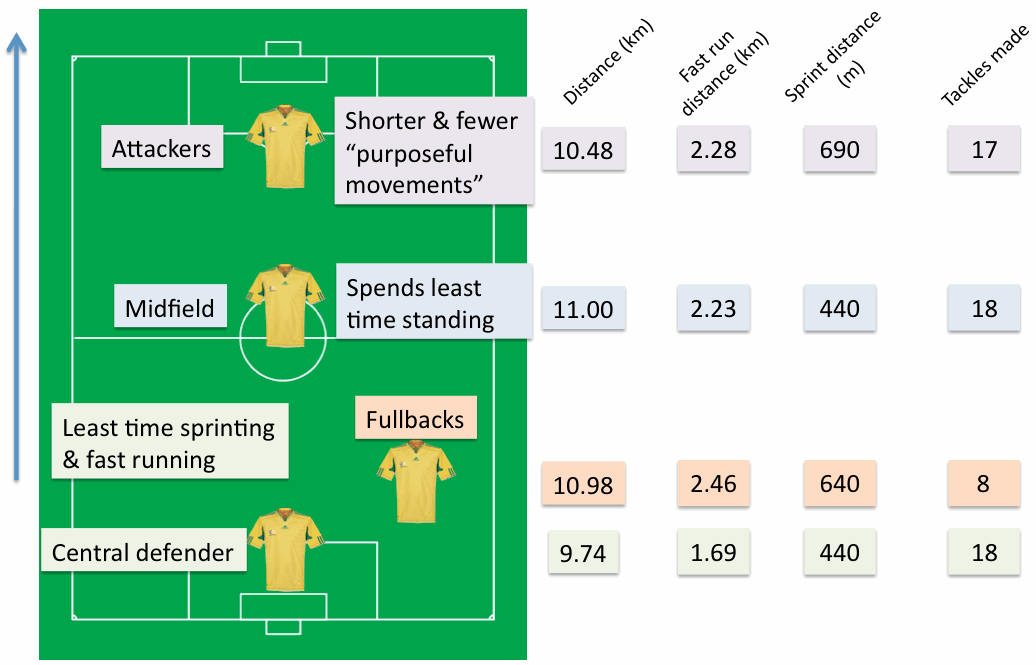
We kick off our science of football series with a look at that physiological demand, and actually ask just what goes into 90 minutes of elite football?

The physiological demand of football

I could tell you the very simple version of the load, and cheat you out of a mass of data, by simply saying that on average, an elite football player plays for 90 minutes at about 70% VO2max, expends about 18kCal/minute, and covers between 10 and 15 km per match.  But this would be obscuring the real challenge, which is that the game comprises multiple sprints, jumps, changes in direction and ball interactions.  Let's look a little more closely at each match.

Below is a graphic that pulls together a number of studies that have looked at the activity profiles of footballers.  What I've done for comparison's sake is to include a similar profile for rugby, with backline players (green) and forwards (red) shown below the football (blue).  Just a word on how this data is actually collected - the most common method is a system of cameras in the stadium, at fixed locations, which track players in their recognized 'grids'.  Some advanced software, complex trigonometry and mathematical algorithms is then able to put together a 2-dimensional reconstruction of where that player has moved, and how fast.

Another method, used for the rugby data below, is GPS, where players wear a GPS unit that tracks where they move and how quickly they run, in the same manner as many of you reading this will use a Garmin to monitor your training (these units are much more expensive, however!).  In all the subsequent graphs, I've opted to simplify as much as possible to illustrate the concepts.  For example, the speeds of running are grouped into four categories - walking, jogging, high speed and sprinting - and these are somewhat arbitrary.  Those interested can look more closely at some of the studies in the bibliography at the end of the post.  So let's have a look at what they show (click to enlarge)!

Summary of football activities


Distances

So the first point is that a footballer covers between 10 and 15km in a match, but this is broken into various running speeds and walking speeds.  In 90 minutes, about an hour is spent standing or walking - that would account for approximately 3km of the distance.  Not surprisingly, more time is spent standing and walking in rugby, because the game is more "static" with less space as a function of the way it is played.

Soccer players also spend more time jogging, running at high speed and sprinting.  A player can expect to cover approximately 5km in jogging, and nearly 3km in sprinting (> 20km/h in this case) in a match.  I must just point out that one of the limitations of these kinds of studies is that the camera system tracks the player and then measures the distance covered above a certain speed.  So for 8 minutes, a player is running at what is defined as sprinting.  However, that player may well have made a short, highly explosive run over 10 m which didn't not get them up to these speeds, and these bursts are often not tracked in this analysis.  They are still "physiologically costly", however, and this is one reason why GPS is so appealing as the next step - it is able to track those accelerations.

We can still measure the number of times players sprint in matches, and it turns out that a footballer will make between 80 and 110 sprints in a match.

Work:rest ratio

And therein lies the crux - 100 sprints in a match, and each one causes a progressive level of fatigue.  The question is how much rest do players get?  One can calculate a work:rest ratio, which in this case, I've worked out as the time spent doing higher speed running and faster jogging (faster than 12km/h), and compared it to the time spent walking, standing and jogging slowly.

The value you get is 1:2.  In other words, for every 10 seconds that a footballer will exert themselves for, they will receive, on average, 20 seconds' rest. That rest may be accumulated in the form of 3 minutes worth of rest, while on other occasions, a player may receive almost no rest for a few minutes.

This is much lower than for rugby, where 10 seconds on is matched by 30 or 35 seconds off.  The crucial challenge, then, for footballers, is to train for these high intensity, short duration bouts, where acceleration and deceleration add significantly to the energy cost, and then to recover so that they can do it again some 30 seconds later!  Other analysis has shown that a footballer will make approximately 28 "purposeful movements" every 15 minutes - about 2 per minute.  These include turns, dribbles, accelerations, decelerations, tackles, passes and jumps.  A player makes about 550 turns a match, and must decelerate about 60 times. 

It's little wonder that the energy cost is high, and given the work:rest ratio, you will not be surprised to learn of a relatively sizeable decline in speed with fatigue during a match.

Energy cost

Finally, the overall energy cost for football has been estimated at about 1400 kCal.  How does that compare?  Rugby is higher, about 15%, and that's because of the impacts in rugby, and the energy involved in 'static activities' in rugby, like scrumming, rucking, maul, tackling, cleaning etc.

However, the energy cost is high - 1400kCal is roughly what a 70kg person would spend running a half-marathon (21km), so you get the idea that the energy demand is high.  That's thanks to those repeated sprints, changes in direction, explosive efforts over 5m.

Football specific activities

Finally, let's look also at football specific activities - the game is more than just running, after all!  To the right is a graphic comparing football to rugby, and it shows the following for football:
  • Players make, on average, 18 tackles per match (sadly, in many cases, this also means a player will dive 18 times a match, feigning injury half the time - one of the scourges of football)
  • The make 15 headers per match
  • As mentioned, players make 100 sprints where they hit speeds in excess of 20km/h
Rugby players, on the other hand, are involved in far more "impacts", which comprise tackles, scrums, sudden stops, ruck involvements, mauls and so forth.

The number varies greatly by playing position, as it does for football, as I'll discuss below.

Ball interactions - moments of truth

Now, the crucial component for a footballer is involvement with the ball.  I believe the matches are won through work OFF the ball, but of course, someone has to score, tackle and pass, and that involves the ball!

Below is a table from a paper by Bloomfield which summarizes ball interactions. It shows that a player will interact with the ball between 90 and 140 times in a match.  There are some differences per position, but there were not statistically different.


The average time of interaction, not shown, is incredibly small.  Remember, the typical interaction is a one-touch pass, or a control-pass.  Players, especially at the elite level, will usually receive the ball with 1m to 5m of space between them and an opponent - half a second (or less) to execute a skill.  Therefore, a player usually has considerably less than a second on the ball.  On occasion, a player will control, dribble, and pass, and may then find themselves with the "luxury" of possession for a 'whole' 3 to 4 seconds!

What if I told you that on average, a player will have a TOTAL of between 60 and 90 seconds of ball time in the entire 90 minutes?  Amazingly, this is the time that a player has to swing the match.  One decisive through ball, one strike, one dribble and pass, but a total of about a minute in a 90 minute match.  It's no wonder that work off the ball becomes so important!  You can try this out when you watch a game later - watch Messi play for Argentina vs Nigeria and time his involvements.  Or Rooney's for England tonight.  Messi probably gets considerably more ball, but the time is short.

Differences by position

Lastly, below is a map of the field, just highlighting some of the key differences between positions on the field, since I know you're probably wondering by now - I've oversimplified the above values into averages, so bear with me providing a more simple overview.  The figure below shows some of the key differences - there are others, but as I said, I don't want to make this more complex and voluminous than it already is!


Fatigue - the stage is set

So, now the stage is set, and understanding just what the activity profile is, and having an idea of the physiological load on a footballer is, we're in a position to discuss fatigue and how it may impact on football performance and outcomes.  We can also now look at altitude with a much better idea of how it might affect physiological performance and hence football performance during the 2010 World Cup.

In the interests of time, however, I think it's time to end this post, and say that fatigue is a topic for the next post!

Enjoy the football this weekend, and join us next week for a closer look at fatigue in football!

Ross

P.S.  I have to emphasize that in all the categories looked at above, I'm presenting a relatively simplified overview of the game and its demands.  There are differences between teams, between players on teams (depending on their role, two midfielders can have completely different physiological profiles, for example) which are not accounted for here.  So in reading this, it's not meant as a fingerprint for every team, every player, every match, but rather a guide.  I hope it adds some insight as you watch the 2010 World Cup.  When we look at fatigue in the next post, I'll tackle some of that insight a bit more!

Bibliography:


Mohr et al, 2003. J Sports Sci, 519 - 528
Bloomfield et al. J Sports Sci & Med, 63 - 70
Carling et al. Sports Med, 2008, 839 - 862
Bangsbo et al, 2006.  J Sports Sci, 665 - 674
Sporis et al, 2009.  J Strength & Cond, 1947 - 1953