Welcome to the Science of Sport, where we bring you the second, third, and fourth level of analysis you will not find anywhere else.

Be it doping in sport, hot topics like Caster Semenya or Oscar Pistorius, or the dehydration myth, we try to translate the science behind sports and sports performance.

Consider a donation if you like what you see here!


Did you know?
We published The Runner's Body in May 2009. With an average 4.4/5 stars on Amazon.com, it has been receiving positive reviews from runners and non-runners alike.

Available for the Kindle and also in the traditional paper back. It will make a great gift for the runners you know, and helps support our work here on The Science of Sport.


Sunday, June 13, 2010

The Vuvuzela: Love it or hate it?

The vuvuzela: Inciting passions as much as the football

I was going to crack on with the science series, looking at fatigue, but something that I almost have to discuss is the controversy that is rapidly building momentum regarding the vuvuzela.  This is the name of the traditional horn that South African football fans blow at football matches.  If you have watched even one single minute of the action so far, you know exactly what it is.  Either that, or you are concerned that every match is about to be halted by the world's largest swarm of bees.

Last year, when the world first met the vuvuzela during the Confederations Cup, there were reports that broadcasters in Europe received complaints from viewers who thought that the broadcaster had messed up the sound.  Or they thought there was something wrong with the TV sets.  Well, now, nine matches in, you know that the sound exists.  The question is:  How do you feel about it?

Growing resentment and patriotic defence

If you hate it, and find it impossible to sit through 90 minutes of a match, then you're not alone.  In fact, your company is growing at an alarming rate.  A facebook site called FIFA-Ban the annoying vuvuzela (horn) from the South Africa World Cup has been set up, and already it has over 60,000 members.  More remarkably, in the 5 or 10 minutes that you might take to read this post, membership will have grown by about 200 people.  And that's on a Sunday afternoon/evening.  It seems destined to build even more in the week.

The controversy over the horn is nothing new.  The complaints around the Confederations Cup last year led to discussion over a potential ban.  That was met with patriotic fury from within South Africa, where the general consensus was that it was part of the atmosphere, the unique character of the tournament.  Interestingly, some of the most vocal criticism now seems to be coming from SA, because the vuvuzela is being blown everywhere, not just in stadia.  Shopping malls, airports, public places - the sound is ubiquitous and I think people's patience is wearing thin.

In the stadium, however, there was encouragement for its use, because it was felt that the horn, being so loud and so distracting to players, would give South Africa a home-ground advantage because we were the only team accustomed to it.  This is debatable, and there are some good studies on home-ground advantage that I'll look at in future.  But the ultimate result of this is that FIFA decided that the Vuvuzela will stay.  Sepp Blatter announced that the vuvuzela will stay, and stay it has.

Medical and scientific concerns - hearing and illness

On a medical and scientific note, there are some concerns too.  Studies have found that the noise levels from a vuvuzela exceed what are considered safe limits for employees.  A Swiss-based company's testing showed that at its loudest, the sound registered 127 dB, compared to a chainsaw at 100 dB.  In SA, a research study found that hearing was affected, and does not seem to return to normal for some time after being exposed to the sound.  And that was just a few horns - the combined effects of perhaps 30,000 in a stadium are anyone's guess.

And then on a perhaps even more serious note, there are concerns over the spread of infection and illness as a result of 30,000 people blowing into the horn in an enclosed space.  South Africa has one of the highest tuberculosis (TB) infection rates in the world, and it is spread through droplets, usually when coughing, spitting or sneezing.  But what about blowing on a plastic horn?  It's a real concern and is another reason why the safety has been questioned.

Communication problems

As for the players, they have complained.  Lionel Messi, best in the world and who had a brilliant first game against Nigeria, said that it was "like being deaf", making communication impossible. Other players have described them as annoying, and Patrice Evra blamed it for France's poor showing against Uruguay, though I'm not sure even the most ardent hater of the horn would sympathize with this excuse.  Unpleasant, perhaps.  But I think this is a relatively minor concern, certainly not grounds to ban it.

My personal view is that it actually doesn't improve the atmosphere. A big part of the atmosphere comes from the crowd's responses to what happens on the field - they sing, cheer, gasp, boo and encourage, but the vuvuzela negates all of this, and so the match actually has no personality.  There are no "valleys" or "peaks", no shifts, only one sound.  If you had no commentary and your eyes were closed, different matches would be indistinguishable.  And their constancy does build and build a level of irritation, which, combined with their sounds pretty much everywhere in South Africa, means I certainly would not complain at a ban.

The broadcaster & sponsor problem

Players and spectators aside, when the broadcasters or sponsors begin to complain to FIFA, then they must sit up and take notice.  Few would defend FIFA for its commercial "muscle" (or greed, whichever one prefers, depending on your viewpoint), but two parties FIFA must look after are their sponsors and their broadcasters.  Both pour enormous volumes of money into the organization, being the two largest sources of revenue by some margin.

And if viewership drops, then the value of both are diminished, and that, more than anything, will get FIFA's attention.  If broadcasters lose viewership, then their potential advertising revenue drops, and that is no laughing matter.  And so if viewership is down, then you can expect the big broadcasters to be leaning heavily on FIFA.  So too, the sponsors need high viewership, because they track the success of their sponsorship partly based on "exposure", which basically means number of views.  Fewer people watching means fewer views, reduced sponsor recognition or awareness, and while that won't affect FIFA's balance right now, it doesn't do much for happy sponsors.  And happy sponsors tend to have bigger wallets.

So, bottom line, TV viewership holds the key.  I will definitely be looking out for that, because I strongly suspect that the neutral fans, and maybe even some die-hard football fans will turn off unless really big teams are playing.  The numbers will come out - will they be 20% lower than Germany 2006? Time zones are no excuse, and so this will be revealing.

What to do?

It's anyone's guess what will be done.  Danny Jordaan, the head of the local organizing committee, hinted that they were relooking at it, having cleared it in the first place.  His words, which confirm the complaints from all sides, are the most 'negative' from anyone involved in the tournament so far, and if I had to read between the lines, I'd say something is brewing.  They certainly reveal that the complaints have been very vociferous, and from 'important' parties.

FIFA have said that they'll ban the vuvuzelas if there were "grounds to do so".  Safety was the one criteria mentioned, and FIFA said they'd ban them if they were used as missiles.  I guess if worst came to worst, FIFA could arrange for a few fans to throw their horns on the field and then issue a ban!  Stranger things have happened, especially when massive money is involved!

Maybe the compromise is to have a block or two of the stands allocated for vuvuzelas.  The problem is that tickets have been sold, and so most fans would not be in these zones.  A straight ban is likely to create major discontent among local fans, accusations of racism, discrimination, exploitation are likely.  I guess there is a sense in which you can understand the likely unhappiness. 

Either way, one group of people will be unhappy, and having given SA the chance to host the party, it may be deemed ungrateful to keep the host from choosing their own "music".  Difficult one for FIFA, that's for sure.

I'd love to know your thoughts, as always.

Ross

The FIFA 2010 WC: A Geography lesson

FIFA 2010 World Cup:  Welcome to South..... America?  Ole!

No scientific post today - I'll follow up yesterday's post on the physiological demands of football with a post on fatigue and performance tomorrow.  But for today, here is something on the lighter side - a screen grab from a news station in Chicago.  Spot the error...


Suddenly, those empty seats at some of the smaller matches make sense. Very funny!

Follow us on Twitter - updates and trivia

Meanwhile, if you can't watch matches, and would like to receive the occasional match update, as well as whatever interesting trivia pops into my mind as I am watching, check out our Twitter feed, which I promise to keep as active as possible during the tournament!

Here is some sample trivia for today - in the last three World Cups, teams that have won their first match have advanced to the second round 85.7% of the time.  In fact, winning at least ONE match sees qualification 75% of the time, such is the pressure of a four team group.  Teams that draw their first match get through 50% of the time, and teams that lose the opener qualify 13% of the time. 

But of course, still all to play for!  Ghana v Serbia is up next, and it's one of the big fixtures of the group stages.

Ross

Saturday, June 12, 2010

Physiology of football: profile of the game

Football analysed:  Moments of truth, physiological profile and fatigue

A football result is determined by the interaction of too many factors to even quantify (this is why coaches are paid big money - their job is to quantify and then optimize them!).  Skill levels, strategy, opposition strategy, individual match-ups all contribute to the final result.  Each player has a (very) limited time to impact on the match and the margin between success and failure is impossibly small.

In this context, the physiology of football, especially with reference to fatigue becomes important.  If a player is 5% short of the level they need to be to complete a 90 minute match, given its demands, then that player may well concede the half-a-second, or the half-a-meter, to the opposition that leads to the game's decisive moment.  Winning and losing are literally separated by these margins, and so it will come as no surprise that a good deal of work has been done on the physical demand of the game, so that coaches know what physiological level players need to be at to avoid fatigue.

We kick off our science of football series with a look at that physiological demand, and actually ask just what goes into 90 minutes of elite football?

The physiological demand of football

I could tell you the very simple version of the load, and cheat you out of a mass of data, by simply saying that on average, an elite football player plays for 90 minutes at about 70% VO2max, expends about 18kCal/minute, and covers between 10 and 15 km per match.  But this would be obscuring the real challenge, which is that the game comprises multiple sprints, jumps, changes in direction and ball interactions.  Let's look a little more closely at each match.

Below is a graphic that pulls together a number of studies that have looked at the activity profiles of footballers.  What I've done for comparison's sake is to include a similar profile for rugby, with backline players (green) and forwards (red) shown below the football (blue).  Just a word on how this data is actually collected - the most common method is a system of cameras in the stadium, at fixed locations, which track players in their recognized 'grids'.  Some advanced software, complex trigonometry and mathematical algorithms is then able to put together a 2-dimensional reconstruction of where that player has moved, and how fast.

Another method, used for the rugby data below, is GPS, where players wear a GPS unit that tracks where they move and how quickly they run, in the same manner as many of you reading this will use a Garmin to monitor your training (these units are much more expensive, however!).  In all the subsequent graphs, I've opted to simplify as much as possible to illustrate the concepts.  For example, the speeds of running are grouped into four categories - walking, jogging, high speed and sprinting - and these are somewhat arbitrary.  Those interested can look more closely at some of the studies in the bibliography at the end of the post.  So let's have a look at what they show (click to enlarge)!

Summary of football activities


Distances

So the first point is that a footballer covers between 10 and 15km in a match, but this is broken into various running speeds and walking speeds.  In 90 minutes, about an hour is spent standing or walking - that would account for approximately 3km of the distance.  Not surprisingly, more time is spent standing and walking in rugby, because the game is more "static" with less space as a function of the way it is played.

Soccer players also spend more time jogging, running at high speed and sprinting.  A player can expect to cover approximately 5km in jogging, and nearly 3km in sprinting (> 20km/h in this case) in a match.  I must just point out that one of the limitations of these kinds of studies is that the camera system tracks the player and then measures the distance covered above a certain speed.  So for 8 minutes, a player is running at what is defined as sprinting.  However, that player may well have made a short, highly explosive run over 10 m which didn't not get them up to these speeds, and these bursts are often not tracked in this analysis.  They are still "physiologically costly", however, and this is one reason why GPS is so appealing as the next step - it is able to track those accelerations.

We can still measure the number of times players sprint in matches, and it turns out that a footballer will make between 80 and 110 sprints in a match.

Work:rest ratio

And therein lies the crux - 100 sprints in a match, and each one causes a progressive level of fatigue.  The question is how much rest do players get?  One can calculate a work:rest ratio, which in this case, I've worked out as the time spent doing higher speed running and faster jogging (faster than 12km/h), and compared it to the time spent walking, standing and jogging slowly.

The value you get is 1:2.  In other words, for every 10 seconds that a footballer will exert themselves for, they will receive, on average, 20 seconds' rest. That rest may be accumulated in the form of 3 minutes worth of rest, while on other occasions, a player may receive almost no rest for a few minutes.

This is much lower than for rugby, where 10 seconds on is matched by 30 or 35 seconds off.  The crucial challenge, then, for footballers, is to train for these high intensity, short duration bouts, where acceleration and deceleration add significantly to the energy cost, and then to recover so that they can do it again some 30 seconds later!  Other analysis has shown that a footballer will make approximately 28 "purposeful movements" every 15 minutes - about 2 per minute.  These include turns, dribbles, accelerations, decelerations, tackles, passes and jumps.  A player makes about 550 turns a match, and must decelerate about 60 times. 

It's little wonder that the energy cost is high, and given the work:rest ratio, you will not be surprised to learn of a relatively sizeable decline in speed with fatigue during a match.

Energy cost

Finally, the overall energy cost for football has been estimated at about 1400 kCal.  How does that compare?  Rugby is higher, about 15%, and that's because of the impacts in rugby, and the energy involved in 'static activities' in rugby, like scrumming, rucking, maul, tackling, cleaning etc.

However, the energy cost is high - 1400kCal is roughly what a 70kg person would spend running a half-marathon (21km), so you get the idea that the energy demand is high.  That's thanks to those repeated sprints, changes in direction, explosive efforts over 5m.

Football specific activities

Finally, let's look also at football specific activities - the game is more than just running, after all!  To the right is a graphic comparing football to rugby, and it shows the following for football:
  • Players make, on average, 18 tackles per match (sadly, in many cases, this also means a player will dive 18 times a match, feigning injury half the time - one of the scourges of football)
  • The make 15 headers per match
  • As mentioned, players make 100 sprints where they hit speeds in excess of 20km/h
Rugby players, on the other hand, are involved in far more "impacts", which comprise tackles, scrums, sudden stops, ruck involvements, mauls and so forth.

The number varies greatly by playing position, as it does for football, as I'll discuss below.

Ball interactions - moments of truth

Now, the crucial component for a footballer is involvement with the ball.  I believe the matches are won through work OFF the ball, but of course, someone has to score, tackle and pass, and that involves the ball!

Below is a table from a paper by Bloomfield which summarizes ball interactions. It shows that a player will interact with the ball between 90 and 140 times in a match.  There are some differences per position, but there were not statistically different.


The average time of interaction, not shown, is incredibly small.  Remember, the typical interaction is a one-touch pass, or a control-pass.  Players, especially at the elite level, will usually receive the ball with 1m to 5m of space between them and an opponent - half a second (or less) to execute a skill.  Therefore, a player usually has considerably less than a second on the ball.  On occasion, a player will control, dribble, and pass, and may then find themselves with the "luxury" of possession for a 'whole' 3 to 4 seconds!

What if I told you that on average, a player will have a TOTAL of between 60 and 90 seconds of ball time in the entire 90 minutes?  Amazingly, this is the time that a player has to swing the match.  One decisive through ball, one strike, one dribble and pass, but a total of about a minute in a 90 minute match.  It's no wonder that work off the ball becomes so important!  You can try this out when you watch a game later - watch Messi play for Argentina vs Nigeria and time his involvements.  Or Rooney's for England tonight.  Messi probably gets considerably more ball, but the time is short.

Differences by position

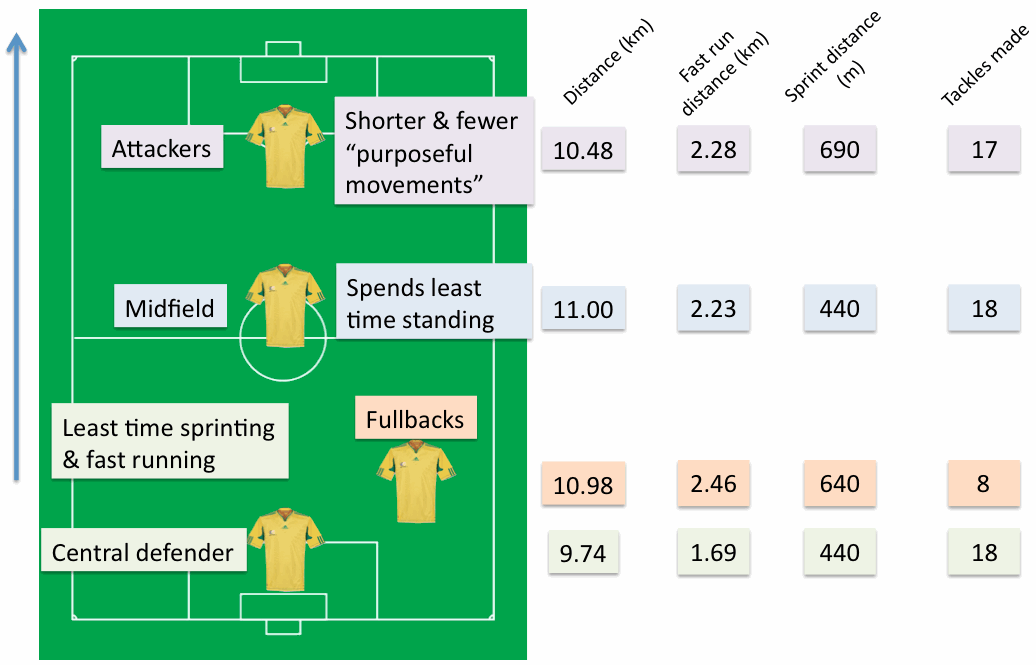
Lastly, below is a map of the field, just highlighting some of the key differences between positions on the field, since I know you're probably wondering by now - I've oversimplified the above values into averages, so bear with me providing a more simple overview.  The figure below shows some of the key differences - there are others, but as I said, I don't want to make this more complex and voluminous than it already is!


Fatigue - the stage is set

So, now the stage is set, and understanding just what the activity profile is, and having an idea of the physiological load on a footballer is, we're in a position to discuss fatigue and how it may impact on football performance and outcomes.  We can also now look at altitude with a much better idea of how it might affect physiological performance and hence football performance during the 2010 World Cup.

In the interests of time, however, I think it's time to end this post, and say that fatigue is a topic for the next post!

Enjoy the football this weekend, and join us next week for a closer look at fatigue in football!

Ross

P.S.  I have to emphasize that in all the categories looked at above, I'm presenting a relatively simplified overview of the game and its demands.  There are differences between teams, between players on teams (depending on their role, two midfielders can have completely different physiological profiles, for example) which are not accounted for here.  So in reading this, it's not meant as a fingerprint for every team, every player, every match, but rather a guide.  I hope it adds some insight as you watch the 2010 World Cup.  When we look at fatigue in the next post, I'll tackle some of that insight a bit more!

Bibliography:


Mohr et al, 2003. J Sports Sci, 519 - 528
Bloomfield et al. J Sports Sci & Med, 63 - 70
Carling et al. Sports Med, 2008, 839 - 862
Bangsbo et al, 2006.  J Sports Sci, 665 - 674
Sporis et al, 2009.  J Strength & Cond, 1947 - 1953

Friday, June 11, 2010

FIFA 2010: Let's Roll

Game on!

You'll forgive me for not posting analysis today!  The World Cup begins in just over 2 hours, and if I described the nation as being at a standstill, I would be doing it a disservice. 

So, to herald the opening match of the 2010 World Cup, here are two videos.

First, the best of the songs associated with the World Cup.  This is by K'Naan, and it was picked up by Coca-Cola for their "History of Celebration" advertising campaign.  It's a great "anthem".


Next, a look back at the 2006 World Cup from Germany.  As we prepare to look forward, 64 games into the future, we start by looking back, to give a taste of what to expect.  This is a great video, with great music, and it's high on inspiration value!


Enjoy, and let's play!

Ross